Last month saw the sad loss of another good friend of Veloce Publishing, and a true great from the world of motoring and auto journalism, Graham Robson, who died peacefully on 5 August at his home in Dorset.
Graham lived only a short drive along the coast from Veloce HQ, and was a frequent visitor throughout the year. With over 20 Veloce books to his name – and even an entire series in Rally Giants – Graham often popped-in to talk shop and answer questions about his latest work.
He was also equally inclined to pop in for a coffee and a catch-up, happy to chat about any and every subject from the latest engineering tech, to behind-the-scenes rally stories that only someone who was there could tell – as well as a myriad of things auto-related or otherwise. A dog lover with a soft spot for British Bulldogs, he was equally at home talking pups and pooches as he was pistons and prototypes.
Graham was a straight-talking Yorkshireman, and proud of it. He was also proud of his achievements, but never in a boastful way. With such a long and varied history, he had the remarkable ability to put his own achievements into context without hyperbole or ego creeping in. His directness and desire to get to the nitty-gritty of a subject is evident from his writing, and all Velocisti who had the pleasure to work with him could expect nothing less than utter professionalism and accuracy … with a rollicking good tale or two thrown in for good measure.
A welcome figure on the talking and eventing circuits, Graham was a regular up and down this country, and the USA, commentating, compering and presenting with a knowledge and humour that always made for engaging, enlightening and fun listening; he rapidly became a firm favourite with crowds and organisers alike. Our YouTube channel has a number of videos of Graham that are well worth a watch, including this great Author Profile, recorded in 2014.
His Veloce books hint at just how broad his knowledge was, covering everything from the technicalities of groundbreaking Rally cars, to the global commercial pressures that shaped empire-building brands. He was a member of the Guild of Motoring Writers, the winner of many national and international awards and the author of nearly 170 books. His personal experiences of the people, places, and races that have become landmarks in automotive history meant he could talk with an authority unmatched by many writers.
Graham will be sorely missed by all the Velocisti. What better way to celebrate Graham's life and work than with his Veloce titles, from his first Veloce book in 1998, Cortina: The Story of Ford’s Best Seller, to his soon-to-be published Classic Reprint edition of The Cars of BMC.
The complete history of these ultimate driving machines
Fully updated, highly detailed, this brand-new edition of Graham Robson’s original Haynes publication explores every aspect of BMW M3 history, including its motorsport success worldwide. From the original E30 of 1986, through E36, E46, and E90 to the 6th gen of 2020, and the M4, it includes full, detailed specifications for each generation, and brings the M3 story right up to the present day, covering all models produced between 2013 and 2021, including M4.
The definitive history of the hugely successful model which stayed in production for five generations, enjoyed great success in motor racing and rallying and which redefined the family car. With over 180 colour and black and white photos this is the fascinating story of a incredibly successful car.
SKU V5100P • Paperback or eBook • 20.7x25cm • 160 pages • pictures • Flowing format eBook
Cosworth
The Search for Power (6th Edition)
This book covers the entire history, life and times of the famous British high-performance engineering company, from its 1958 foundation by Mike Costin and Keith Duckworth, through its often-exciting and always fascinating evolution, to its expansion and worldwide success in both motorsport and high-performance road cars.
The story of the 97 Ford Focus WRC cars during their 12-year rallying career; there were 44 World Championship victories, and the team won the World Rally Manufacturers’ Championship. Drivers included Colin McRae, Carlos Sainz, Marcus Grönholm and Mikko Hirvonen, with sponsors including Martini, BP (and Castrol), and the state of Abu Dhabi.
In 1965, Colin Chapman persuaded Ford to underwrite development of a V8 for the new 3000cc Grand Prix formula. Built by Cosworth, the new DFV engine won Lotus four World Championship Grands Prix in 1967. A year later, and now available to other constructors, the engine began its domination of Grand Prix racing. This important book is illustrated with more than 300 photographs, most of which come from the UK Ford Motor Company’s own archives.
Starting with the original Standard prototype of 1903, this book covers the scores of Standard models built until the brand was discontinued in 1963 (Britain) and 1987 (India). It also covers the Ferguson tractor involvement, millitary aero-engine manufacture, military aircraft manufacturer (including Beaufighter and Mosquito fighter-bombers), Rolls-Royce Avon turbo-jet military engine manufacture, and Triumph cars. This is the first definitive book to cover this major British marque.
The Cars of BMC is the most detailed record of the origins, operations, and legacy of one of Britain's most historically important industrial concerns. This is a unique record from one of the most respected automotive historians, and a key player in the British automotive industry. This new edition of The Cars of BMC covers the cars of the period 1945 to 1975, and the following marques: Austin; Austin-Healey; Innocenti; Metropolitan; MG; Morris; Riley; Vanden Plas; Wolseley; British Motor Holdsin (BMH) and British Leyland, plus subsidiaries and overseas connections.
Lasting six weeks and covering 16,000 miles from London to Mexico City via some of the most varying, tortuous and difficult terrain on three continents, the 1970 World Cup Rally was a unique high-speed event. Attracting many serious works teams such as Ford and British Leyland, it was, and remains, the toughest rally of all time. This book, now reprinted in paperback, tells the complete story.
SKU V5228P • Paperback or eBook • 22.5x22.5cm • 208 pages • 237 pictures • Flowing format eBook
The Great British Rally
RAC to Rally GB - The Complete Story
From the running of the 1932 RAC rally, mainly a social event, to the present day, when Rally GB is a high-speed endurance World Championship rally, this is the very first all-embracing history of an important part of British motorsport history. Descriptions of every event, opinions, and results are brought together for the very first time, with year-by-year accounts of all events in the Rally’s history, and copiously illustrated with period photographs. It also covers the many and varied challenges posed by such crises as foot and mouth disease, weather conditions, and controversy over rules and regulations: this book is truly the definitive guide.
The distinguished 130-year history of the Triumph company from original pedal cycles, to the first Triumph cars, and then every model up to the end of production. The authors reveal the in-house politics of the company, its design and engineering achievements, competition activities, and its international sales and marketing success.
The Audi Quattro is a Rally Giant because it was the first to combine four-wheel-drive and a turbocharged engine – not the most sophisticated, but it was the first, and very successful. It was also the first to run with more than 300bhp. As it was re-homologated/transformed from Group 4 into Group B in 1983, it was also the first successful Group B car.
SKU V5110P • Paperback or eBook • 21x19.5cm • 128 pages • 116 pictures • Flowing format eBook
Austin Healey 100-6 & 3000
Between 1957 and 1965 the six-cylinder-engined Austin Healey evolved into a formidable and increasingly specialised rally car. By any standards, it was the first of the ‘homologation specials’ – a type made progressively stronger, faster, more versatile, and more suitable for the world’s toughest international rallies. This book tells its story.
SKU V5324P • Paperback or eBook • 21x19.5cm • 128 pages • 140 pictures • Flowing format eBook
Fiat 131 Abarth
Fiat entered rallying in 1970, with the aim of becoming World Rally Champion – and it was the 131 Abarth of 1976-1980 which made that possible. It soon began winning World rallies, and, in 1977, 1978 and 1980, the 'works' team also won the World Championship for Makes, paving the way for successors the Lancia Rally 037 and the Delta Integrale.
SKU V5111P • Paperback or eBook • 21x19.5cm • 128 pages • 100 pictures • Flowing format eBook
Ford Escort Mk1
The story of the Ford Escort MkI, a car that delivered everything its predecessor, the Lotus-Cortina, had promised. Versatile, accessible and competitive at all levels, it dominated international rallying throughout the 1970s, and became hugely popular with teams and spectators alike.
SKU V5107P • Paperback or eBook • 21x19.5cm • 128 pages • 107 pictures • Flowing format eBook
Ford Escort RS Cosworth & World Rally Car
The Escort RS Cosworth became Ford's most successful model since the legendary Escorts of the 1970s. The combination of Cosworth power, 4WD transmission, and an effective aerodynamic package made it a Rally Giant in all conditions, making this generation of Escorts the most effective rally car that Ford had produced at that time.
The Ford Escort MkII, the RS1800, became Ford’s most successful rally car, and is still winning historic events today. It brought new standards to the sport, inspiring many others to copy it. This books contains full details of every ‘works’ Escort MkII that went rallying, plus driver and personality profiles, and detailed car evolution.
SKU V5109P • Paperback or eBook • 21x19.5cm • 128 pages • 112 pictures • Flowing format eBook
Lancia Delta 4WD/Integrale
The HF 4WD – a compact, five-door Lancia – dominated world-class rallying for six years, winning innumerable events, World Championships for Drivers, and World Championships for Manufacturers. Alongside the cars, driving heroes such as Markku Alan, Didier Auriol, Miki Biasion, Juha Kankkunen and Carlos Sainz also became legendary in this period.
This book describes the birth, development and rallying career of the Lancia Stratos, Europe’s very first purpose-built rally car, in the mid/late 1970s. It provides a compact and authoritative history of where, when and how it became so important to the sport, as well as telling the story of the team.
SKU V5526P • Paperback or eBook • 21x19.5cm • 128 pages • 131 pictures • Flowing format eBook
Mini Cooper/Mini Cooper S
This book describes the birth, development, and rallying career of the BMC Mini-Cooper/Mini-Cooper in the 1960s, providing a compact and authoritative history of where, when and how it became so important to the sport. Even today, works Minis appear at every gathering of classic cars – and in 2009, Mini celebrates its 50th birthday. Packed with over 100 photographs, this book is a fitting and timely tribute to a much-loved Rally Giant.
Peugeot designed, developed, campaigned and won with the first truly sophisticated four-wheel-drive Group B Car – the 205 Turbo 16. Detailing the cars, the influences, and the personalities behind a magnificent success story, this book is packed with illustrations, and technical data on this innovative car, and is a must for any rally fan.
SKU V5325P • Paperback or eBook • 21x19.5cm • 128 pages • 100 pictures • Flowing format eBook
Saab 96 & V4
The story of the front-wheel-drive Saab 96, which made the brand into a rally icon in the 1960s. It succeeded in events as diverse as the Monte Carlo, Britain's RAC Rally, many Scandinavian events, and the Spa-Sofia-Liége Marathon. The 96 and V4 models produced victory where no-one expected it.
SKU V5332P • Paperback or eBook • 21x19.5cm • 128 pages • 135 pictures • Flowing format eBook
Subaru Impreza
This book describes the birth, development, and rallying car of the turbocharged, four-wheel-drive Subaru Impreza in the 1990s and early 2000s, providing a compact and authoritative history of where, when and how it became so important to the sport.
SKU V5322P • Paperback or eBook • 21x19.5cm • 128 pages • 96 pictures • Flowing format eBook
Toyota Celica GT-Four
This book describes the birth, development, and rallying career of the Toyota Celica GT-Four, providing a compact and authoritative history of where, when and how it became so important to the sport.
October saw the loss of an icon of rock music, and an inspiration to generations of guitar players. Eddie Van Halen passed away at age 65. Eddie Van Halen burst onto the music scene in 1978, with the eponymous album Van Halen. The group was formed in 1972, by Eddie and brother Alex, and continued with varying lineups – including with son, Wolgang – until the present day.
As someone who grew up listening to Van Halen, learning riffs and songs that I still play today (albeit at a fraction of the volume and with a fraction of the talent), I can vouch for the huge effect he had on music, then and now. I may have been a little late to the Van Halen party, but I can still remember the first time I heard the blistering guitar tones: a modded Strat, rewound PAF pickups blasting through a Marshal Plexiglass powered by a Variac (yeah – I’m a guitar nerd).
Eddie's iconic home-made 'Frankenstrat.'
That sound was to become Van Halen’s trademark 'brown sound,' and partnered to his fluid two-handed playing style, became the defining tone for a generation of guitarists. The song was Mean Street, and the album was Van Halen’s fourth, Fair Warning; it was a hair-raising 'eureka' moment for millions of wannabe Guitar Gods the world over. At that moment, I knew that I was going to be Van Halen one day. Of course, without the skills or ability, that dream never materialised (although I do play an authentic Drop Dead Legs).
Whilst the guitarists among you will be familiar with Eddie’s techniques, tones, and guitars, you may not be so familiar with his love of cars. Along with his fellow bandmates, Eddie loved high-speed driving, almost as much as he loved high-gain playing. His extensive collection changed much over the years, working through a selection of Lamborghinis and Ferraris, to what was to become his last favourite (more on that later). Today, we pay tribute to one of the most influential guitarists of all time, in a manner befitting Veloce – with a look at some of his stunning car collection.
Possibly one of Eddie’s most well known cars, is this custom Chevrolet C1500 pickup – or Van Hauler. Despite a fairly understated appearance, this beast was built by Hot Rods by Boyd and designed by none other than Chip Foose.
Sporting subtle Frankenstrat inspired paint, with mods including a rear rollpan, and billet grille, it also sported a not-so-subtle 6.2-litre V8 LT1 engine swap, and independent rear suspension from a Corvette. The truck fell into disrepair, but was restored by Hot Rods by Boyd in 2009, and was auctioned in 2010. A second truck with a more extensive paint job was built for Sport Truck magazine, as a giveaway car.
Staying with trucks, Jim Bassett’s Bones Fab Hot Rod and Muscle Car shop built and maintained the gorgeous Dodge COE, above. Already modified when purchased, coming with a 6.9-litre diesel and four-speed manual transmission, it was further 'improved' with a 7.3-litre turbo diesel, ZF five-speed 'box, and overdrive.
EVH’s collection features a number of cars by Bones Fab, and the next example is a fine 1970 Chevrolet Nova. As with most things EVH, the car is modded, featuring a 454 LSX motor, good for 650hp, completely revised rear suspension and brakes, and carbon fibre bonnet and boot. It also looks pretty fine in the Cali sunshine in Tang Yellow Orange paint.
1970 Chevrolet Nova …
… looks good from EVERY angle.
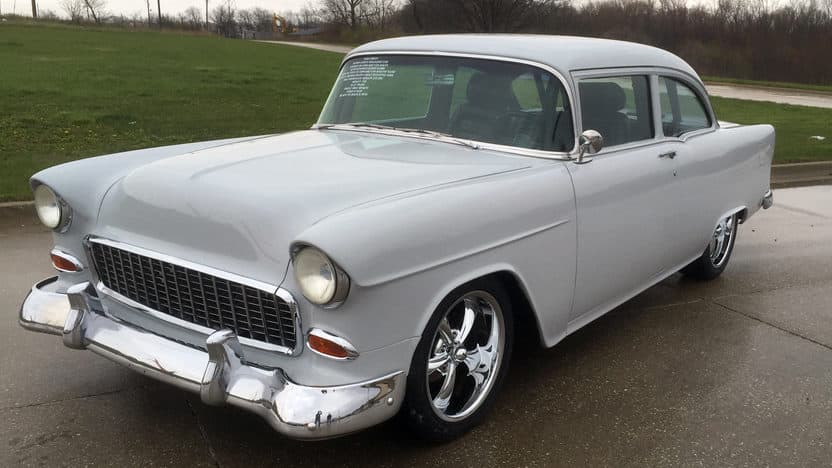
Chevrolet features predominantly in Eddie’s collection, with a 1957 Chevy Nomad, perhaps one of his more 'sedate' cars. It is, though, a beautiful example of period styling, stock air and power steering, and V8 power. Stock and steady it may be, but it still fetched a staggering $930,000 at Barret-Jackson’s 2009 Scottsdale auction. A Chevy with 'a little more gain' than the Nomad, was Eddie’s 1955 210, a 408cu-in small-block shoebox Chevy, which Eddie kept until 2016.
When he wasn’t getting his adrenaline rush on stage, Eddie loved to race on track. He was known to push his cars as hard as his guitars and amps, and the latest car to become his favourite was an eminently pushable Porsche 911 GT3 RS.
Sporting '5150' plates (the name of his recording studio, and 1986 album), when asked about the car by Car and Driver magazine, he said;
For one, it’s just so light. But really, it’s the handling. I don’t know how Porsche did it. We raced in the rain at Buttonwillow, which is my favorite track. We raced in the fucking rain and we never lost it, never spun out. BBI [Autosport] did my suspension. I set it up so you can feel it go and you can actually slide the damn car. It’s the first time ever I’ve been able to four-wheel-drift a Porsche. Every other Porsche I’ve ever had, I’ve spun them all. Well, every 911, anyway.
To borrow from Spinal Tap, Eddie liked to turned things up to 11, in stereo, so what better than a pair of Audi R8s to help the volume? The R8 proved to be a firm favourite with Eddie, owning V8 and V10 versions – both six-speed manuals, and both supercharged. Both pretty quick with EVH behind the wheel, too.
For me, though, the car in Eddie’s collection that shows his true petrolhead credentials, as well as a deep appreciation for the spirit of driving – and trailblazing – is his 1972 Lamborghini Miura S. The car – or rather the engine sound – even made an appearance on the track Panama, from Van Halen’s album 1984; the car was backed into the studio, hooked-up to the microphones, and given a good dose of Eddie’s right foot. Fast forward to 2:54 in the video to hear the unmistakeable tone of a Van Halen V12!
The Lamborghini Miura S. Sounds good too.
Fittingly, the Miura was the first mid-engined production car, the first modern supercar. More than anything, it set the tone for everything that followed … just like the great man himself.
Carl Lender / CC BY (https://creativecommons.org/licenses/by/2.0)
This month sees the debut of Audi's all-new A8 range, the first in the Brand's history to feature electrified drivetrains as standard. Featuring a 48-volt primary electrical system, these new A8s promise a new level of refinement, performance, and – of course – economy.
The new volts wagen from Audi – The all-new Audi A8 range will be the first in the brand’s history to feature an electrified drivetrain as standard. Its combustion engines will be equipped with mild hybrid technology based around a 48-volt electrical system which features as the primary electrical system for the first time.
The A8's hybrid drive comprises two main components: a watercooled, 48-volt belt alternator starter (BAS), and a lithium-ion battery that acts as an accumulator. The BAS complements a conventional pinion starter, which is used only for cold starts, while the lithium-ion battery (stowed in the luggage compartment) has a 10Ah charge carrier capacity.
BAS's advantage becomes clear when approaching roundabouts or red traffic signals. If the traffic signal turns green during braking, while the vehicle is coasting to a stop or if a gap appears for the driver to move into, and the driver releases the brake, the combustion engine is started immediately. There's no delay in acceleration, thanks to the belt alternator starter, which is permanently connected to the combustion engine.
The fourth-generation A8s feature a new noiseless coasting mode, available between 34mph and 99mph, which switches off the engine altogether, for up to 40 seconds, giving zero-emissions. The moment the driver steps on the throttle, the BAS swiftly and smoothly restarts the engine.
The new A8's stop/start function has been improved, too. It's now active from 14mph, and it can even distinguish between different traffic situations. If the road is clear, the BAS starts the engine promptly, so you can drive off swiftly. After a long standstill, or if the drive wants to turn up the aircon, the engine start up switches to extra smooth and silent mode. It even has predictive starting: if the vehicle in front of you moves off, the engine starts even if the brake is applied.
Of course, one of the big factors in hybrid tech, is the recuperation or regeneration of energy, and the A8 comes with some sophisticated management just for this. On-board computers process route data, front-facing camera views, and various sensor data, and calculates the best time to coast or recuperate (the system can even recuperate energy if you get too close to the vehicle in front). The upshot, is that fuel consumption is reduced by as much as 0.7 litres per 100 kilometres.
The new Audi A8 debuts on 11th July, at the first Audi Summit, in Barcelona, Spain.
Further information on powertrain development at Audi is available at
Of course, Audi isn't the only German manufacturer to look into electrical power … Mercedes-Benz are also on the case, as this video highlights … possibly …
Looking to buy one of these iconic cars? Then this app is for you! It will help ensure that you avoid the main pitfalls and end up with your very own dream coupe on the driveway.
The app includes expert advice, with images and videos, on all aspects of buying an Audi TT. Included is a unique Evaluation Calculator so you can assess the true quality of a potential purchase, and make sure you don’t forget to check any of the important areas. You can store key information and notes for easy reference later.
A new take on one of the most iconic Audi models in recent years will be unveiled next month.
At next month’s Geneva Motor Show Audi will pull the wraps from a completely new iteration of the compact sports car that tore up the rulebook and changed the course of design in its class at its 1998 launch. For the third generation of the iconic TT, the designers have reinterpreted a host of ideas from that first, game-changing template.
The front end of the new Audi TT has dominant horizontals. The Singleframe grille is broad and flat. Two contours form a V-pattern over the bonnet. The position of the four rings is also new - they now sit centrally on the hood, echoing the R8.
Struts divide up the large air inlets. The headlights repeat this motif – they are structured with divider struts acting as reflectors for the daytime running light. Audi can supply the headlights as an option with LED technology or its pioneering Matrix LED technology, where controllable individual light-emitting diodes generate the main beam.
Many details of the new Coupé’s profile are reminiscent of the first generation’s classic design. The sill contour forms a powerful light edge and the wide wheel arches constitute distinct geometrical entities. At the front, the wheel arch intersects the bonnet join, which continues over the door as the tornado line and extends all the way to the rear. The flat greenhouse looks like an entity in its own right. The shape of the C-pillar, with a slight kink, gives the TT a powerful, athletic look and enhances the impression of tension.
At the rear, too, horizontal lines reinforce the wide and focused impression. The struts in the rear lights pick up on the headlights’ motif. They remain permanently on – another Audi innovation. The third brake light with a flat strip shape links the two units on either side. All engine versions have two large, round exhaust tailpipes in the diffuser. Like all Audi S models, the TTS features four tailpipes.
Inside, too, the styling is so light it almost seems to float, evoking the clean sports car character of the new Audi TT. The centre console and door trims have flowing, matching shapes. Seen from above, the dashboard resembles the wing of an aircraft. The round air vents, a classic TT feature, have a turbine-like look and incorporate the air conditioning controls. This solution – and the elimination of the central MMI monitor, now replaced by the Audi virtual cockpit – paves the way for the dashboard’s remarkably slim architecture.
Sharper lines and a more dramatic interplay between surfaces will be particularly notable features of the third generation of the Audi TT, but they only scratch the surface of a pedigree sports car that has been systematically refined in every department, both inside and out.
Having this book in your pocket is just like having a real marque expert by your side. Benefit from the author’s years of Audi TT ownership, learn how to spot a bad TT quickly, and how to assess a promising car like a professional. Get the right TT at the right price!
This month we have a staff entry from Jude Brooks, Veloce co-founder and publisher of the Hubble & Hattie imprint, with her Audi TT. The image below is taken from the brand new book Dogs on wheels – Travelling with your canine companion by Norm Mort & published by Veloce.
Me and my TT
I love my Audi TT – really, really, love it – and you'd never expect that, when you consider that my previous car was a Fiat Seicento ...
Maybe it was something to do with turning 50 (gulp) but I decided to invest some of my hard-earned pension pot in a new car, and, as I'd always liked the look of the original TT – that sexy, voluptuous profile – I surprised everyone (and mostly me) by buying one. And I'm not alone, as, apparently, Britain is Audi's best customer for the TT, which figures.
The first day I had it (the day after my birthday), a friend and I (and my dog, Immie) took off for a drive, ending up in Lyme Regis on the south west coast. Top down, the journey there and back was glorious: I had never driven anything like this before, and how I felt was confirmation I'd made the right choice of car.
A 2001 1.8 Quattro (225) Roadster, my gorgeous girl has silver paintwork with black leather interior and black soft top – and curves that put Marilyn to shame! First shown as a concept car at the 1995 Frankfurt Motor Show, the original generation Audi TT was nominated for the 2000 North American Car of the Year Award, and featured in Car and Driver magazine's Ten Best List for 2000 and 2001. It has a wonderful, substantial feel to it – maybe that's something to do with its German engineering – even though it's quite small overall, and, of course, it goes extremely well, more than delivering on speed (thanks to a 225bhp, front-mounted, transversely-oriented engine); sure-footedness (fully independent suspension), and very precise handling. Quattro four-wheel-drive means that not even six inches of snow on a hill poses a problem. And fuel-wise it's not bad at all, helped, of course, by the fact that I drive very conservatively ...
Unless it's raining, I usually have the top down, which is the only way to drive a car like the TT. The very efficient heater and heated seats ensure that Immie and I stay warm and snug in the cockpit, even in minus temperatures, and a crisp, winter morning is just perfect for a spot of topless motoring!
Immie sits on the passenger seat next to me wherever I go; she wears a special canine harness that attaches to the seatbelt when it's in place, and keeps her safe. I know she feels quite at home in the car as often she will lay flat out across the seat and doze off, only waking when I have to move her head in order to apply the handbrake. And when she sits up, ears flying in the breeze, all you can see from the back are what appear to be two blondes in a sports car having a wonderful time! Jude Brooks
Do you have an unusual car/motorcycle with a story to tell?
We want to see it!
Send photos & description to prize@veloce.co.uk
We will pick one a month, and any we feature will win an Essential Buyer's Guide (worth £9.99 / $19.95) of your choice.
Click below to browse the whole series.
Le Mans premiere for Audi R18 ultra and R18 e-tron quattro
Audi Sport Team Joest made efficient use of the only testing opportunity of the year at Le Mans. The two Audi R18 e-tron quattro and the R18 ultra vehicles covered a total distance of 4,497 kilometres on the circuit that is primarily made up of public roads. From the suspension set-up and aerodynamics through to tyre tests, handling of the LMP sports prototypes with varying amounts of fuel and the comparison of the concepts, the engineers gathered valuable data for the year’s most important endurance race. Occasional precipitation in some areas made for changeable conditions on the 13.629-kilometre track though.
Marco Bonanomi, the only Audi factory driver who has previously never participated in the Le Mans 24 Hours, qualified for the grid by completing ten mandatory laps and numerous additional kilometres in the number "4" Audi R18 ultra.
The day’s fastest time of 3m 25.927s was achieved by Allan McNish. An excursion by the Scotsman at Tertre Rouge, though, put a premature end to the track presence of car number "1" one hour before the test was over. With positions one, two, three and six plus a wealth of valuable data Audi concluded the test day on an extremely positive note and thoroughly completed its preparations.
New from Veloce!
Le Mans Panoramic
By Gavin Ireland.
The Le Mans 24 Hours is the ultimate endurance race, and a classic feature of the motorsport calendar. This book captures the sheer scale and drama of this legendary race as never before, using specialist panoramic photography to give an unprecedented wide angle view of how the race is entered, watched, won, and lost. It is a timeless tribute to the Le Mans 24 Hours.
More info.
Audi R8 (WSC Giants) by Ian Wagstaff.
The history of the world’s most successful endurance racing car: the Audi R8. Featuring reports of all of its 80 races, plus profiles of the 35 drivers who raced the car between 2000 and 2006 – as well as the Audi R8R and R8C of 1999. Features individual chassis details, results, and observations from significant individuals involved with the R8. More info.




 Posts
Posts

