Our latest author interview is live on the Veloce YouTube channel.
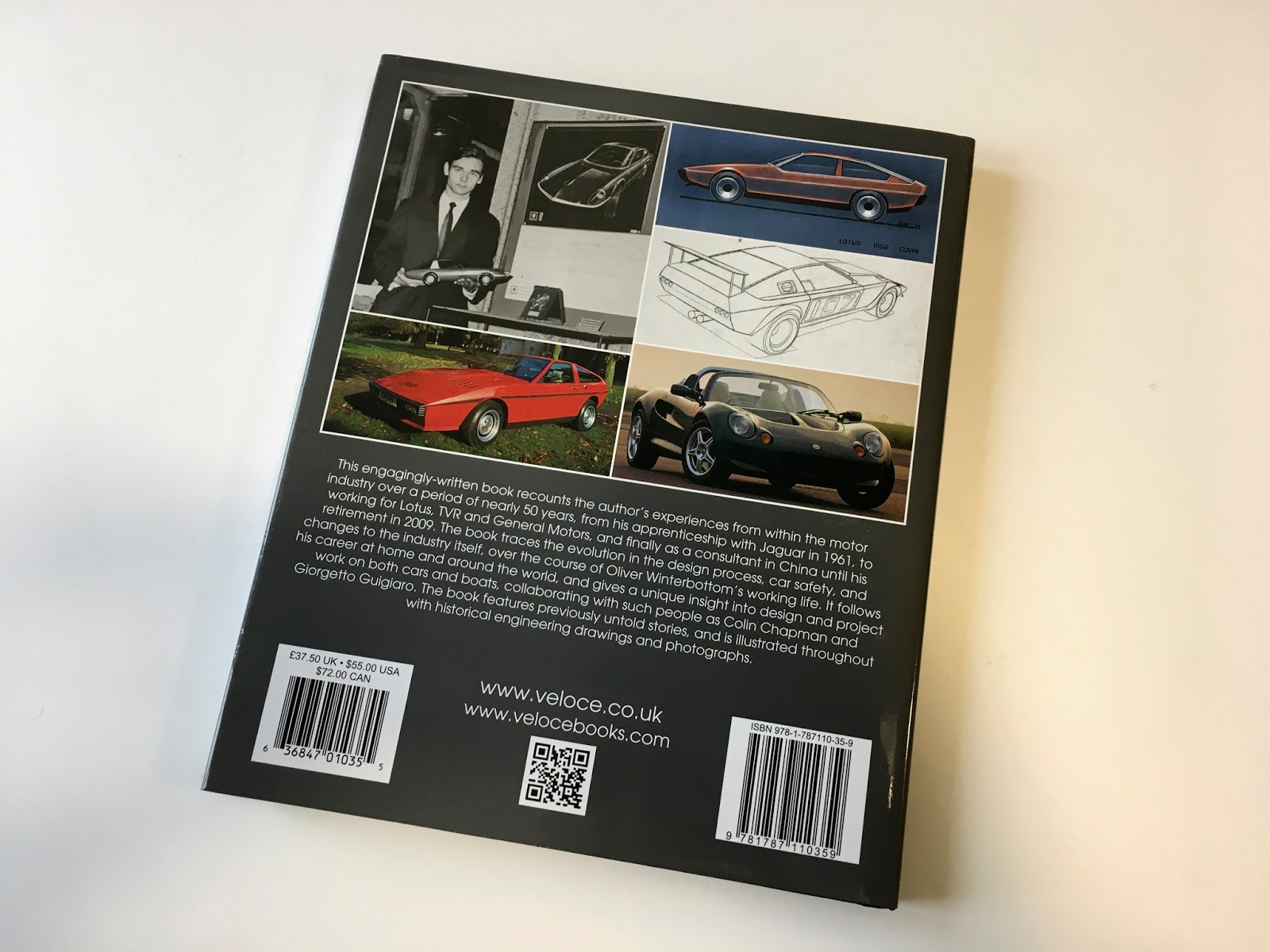
Oliver Winterbottom spent his whole career designing cars, and, for a short period, boats. He started his working life as an engineering apprentice at Jaguar Cars before spending a further five years there as a staff designer. In 1971 he joined Lotus Cars as the Design Manager. He was responsible for the styling, body engineering and aerodynamics of their vehicles until 1975 when he transferred to Colin Chapman's luxury boat company.
A short period of self employment saw the start of the TVR Tasmin range of sports cars. He then moved north to join the company through to the launch of the Tasmin Convertible and 2 + 2. In 1980 he returned to Lotus to lead the joint sports car project with Lotus and Toyota. After the completion of a prototype running vehicle he left for a short period in Detroit, USA.
Working for General Motors he was a project manager on two low volume vehicles for them. Returning to the UK he rejoined Lotus where he held a number of senior management positions in engineering and vehicle safety work. He resigned in 1998 and set up a consultancy, Norfolk Automotive Limited. His clients included a number of companies in China until he retired.
Throughout his career he maintained a "hands on" approach to both the design and the development of a wide range of products.
A Life in Car Design gives a unique insight into design and project work for a number of leading companies in the motor industry, including Jaguar, Lotus, TVR and General Motors.
The book recounts the author's experiences from within the industry, tracing the changes in the design process over a period of nearly 50 years, and follows his career at home and around the world. It shows how the change from imperial to metric measurements and the growing use of computers revolutionised the quality and accuracy of modern vehicles. It also covers the issues and challenges of meeting project targets, and some of the issues that can deflect those efforts. It features previously untold stories, and is thoughtfully illustrated with historical engineering drawings and photographs.
As well as informing automobile enthusiasts it is also hoped that this book will inspire upcoming generations to consider a career in the creative field.
Available March 2017! A Life in Car Design – Jaguar, Lotus, TVR. Click here for more information about the book.
Our featured video this month is an interview we recorded with Mike Dicks, he tells us about how his new book came about with Veloce's Hubble & Hattie imprint, and how his training is going with Scrabble as teacher.
Mike&Scrabble is an often funny, sometimes melancholy, and occasionally accurate guide to understanding the relationship between a dog and a human. A picture book for adults that grew out of one human trying to remember why he ended up with a dog, and sharing his thoughts as pictures on social media.
We asked Nigel Bennett a few questions about his career in motor racing ...
How big was the learning curve in F1 during the 70s and 80s, an era when aerodynamics became so important?
For me, the whole business was a huge learning curve during this period, even though I had been involved in top level motor racing since 1967 as a Firestone racing tyre designer and engineer to many of the top teams in F1 and sports cars. However, from 1974 I was working as an engineer within racing teams – Hesketh and Team Lotus until 1978 – so I was in at the deep end, learning about car construction, working with the mechanics and home based fabricators, machinists and designers. And, of course, motor racing as an industry was learning fast too, particularly about aerodynamics.
Initially in the 60s, it became apparent that downforce, through the use of wings, meant that cornering grip was increasing rapidly, but so was drag: so subtle compromises were required to find the best combinations for each circuit. Then of course the huge ‘find’ was when, partly by accident, it was discovered that air flow beneath the car could be channelled to produce unheard of levels of downforce, with remarkably small increases in drag. All this was discovered at Team Lotus during my four years with the team.
And working for Colin Chapman, probably the greatest innovator the sport has seen, was a huge advantage to me when I left Team Lotus, and started to design F1 and Indycars myself.
You say in your book that you believe the 80s and 90s were the most wonderful period of motor racing. Why?
What was so challenging in Indycar racing in that period was, like F1, we raced on street circuits and road circuits, but Indycars also raced on Short Ovals and Superspeedways. At the one mile Short Ovals, for instance at Phoenix and Milwaukee, there was racing 3 and 4 abreast at times, and no lack of overtaking. And the G-forces were enormous: at Phoenix the drivers would be pulling some 5G lateral for over 7 seconds through turns 3 and 4. And the speeds at Michigan, or Indianapolis, were tremendous with lap average speeds of around 230mph and top speeds of over 240 mph. The aero rules, and even suspension parts, differed for these different types of circuits and with over 800bhp the cars were fast and spectacular.
Indycars raced not only in the USA, but in Canada, Brazil, Australia and,on occasion, Germany and Great Britain. Then, on both sides of the Atlantic, motor racing was still a sport with much less evidence of big business than is the case today. Teams were so much smaller, budgets were a fraction of today levels, and racing was all the more enjoyable for that.
Hesketh was an extraordinary private team, famous for partying as hard as it raced: your time with Bubbles, Lord Alexander, the Doc and James Hunt must have been extraordinary?
Even in the days when F1 was serious, but fun, Hesketh Racing was an anomaly. It had a reputation of enjoying the parties with the racing as a side show. False! There was a serious side to the team.
I only worked for the Hesketh Racing for a few months, and fresh from a Firestone tyre background, my learning curve was steep. Many of the wild parties happened in the earlier days before I joined as, by then, money was getting tight and the F1 team folded at the end of the year. Despite the Lord’s antics, the team had excellent hard working mechanics. Harvey Postlethwaite was a talented designer and ‘Bubbles’ Horsley a fine Team manager. James Hunt? Well there’s plenty about him on film and in print. And he still owes me £5!
Have you seen the film Rush? How accurately, in your view, does it portray James Hunt and his rivalry with Niki Lauda?
From what I saw Hunt and Lauda were good friends., despite the obvious rivalry on the track. I thought the Rush Lauda character was brilliant, Hunt less so. The real Hunt was more extreme and outrageous than the film dared to show!
What was it really like working with the genius Colin Chapman? Have you got any anecdotes you can share?
Without doubt a brilliant man, very brave, charming, but a bit of a rogue none the less. A fantastic leader with a mercurial brain, he could persuade ordinary mortals to do things, complete tasks, they would never dream possible on their own.
Colin loved to be the centre of attention, with a loud laugh, but could fix you with a steely eye if he thought you weren’t giving your all.
100 hour weeks were not uncommon working for Colin Chapman!
A true innovator, an original thinker, but many of his schemes were failures, it’s just that he came up with so many ideas, that the innovator image stuck. For instance, he claimed he thought through the possibilities of ground effect while on holiday, but, in fact, that was far from the truth as I explain at great length in my book.
His main failure as a designer (thought he seldom, if ever produced final drawings, rather than sketches), was he always wanted to be one step ahead, and developing a design to it maximum, bored him. He always wanted to innovate, at many times to his cost.
He was a good pilot, but wasn’t above flying to his own rules when it suited him. He once flew himself and a couple of crew members to Holland, his secretary had filed the flight plan and informed the local airfield at which he had declared he would land. En route he changed his mind and landed at another airfield (without informing anyone) and departed for the race meeting in a rental car. On arriving back on the Sunday night he found padlocked chains wrapped around the plane’s props. It seems the first airfield, on his non arrival, had assumed he was missing over the North Sea, and alerted the authorities who started a costly search. The police were not amused and took steps to teach him a lesson.
What was it like seeing ‘your’ cars on the front row at Indianapolis?
Great pride that I ,and my design team, had come up with a car that was ahead of the competition, and thankful that I was working for a great team such as Penske racing, which could deliver the true potential of my cars.
What role has tyre technology played in top level motorsport through your working life?
Of course tyres have always been super important in motor racing. Nowadays, there is seldom any tyre competition in that most series, including F1 and Indycars, have one supplier, so it is down to the teams to get the very best from the tyres they are supplied with. Back when I was involved, there were often two or three tyre suppliers, so a tyre war could make it unfortunate if one was contracted to an inferior product. This was very much the case in the mid- to late-nineties, when Penske suffered considerably being contracted to a supplier which was a step behind in development.
When I worked for Firestone, in the late 60s and 70s, there was intense competition with Goodyear and Dunlop, and we often came out on top with superior Firestone products in F1 and Sports cars. Again, many great tyre innovations were stumbled upon by accident, including how slick, plain treaded tyres came about, a story recounted in my book.
What is unique about your book amongst other books that cover a similar era of motorsport?
I believe the book is unusual. Firstly, because it covers a long period in motor racing history from the point of view of one person, but also there are chapters by my main rival designer and the Penske team manager. Secondly it is not only about F1, or even F1 and Sports cars, but also about tyre design and development back in the 60s and 70s.
You met and worked with many great motor-racing characters, which of them really stand out and why?
Mauro Forgheiri ,who took the time to talk to me about his cars, and explain how he went about tuning his cars, his subtle use of shock absorber settings to change a car’s balance. A great character who would organise great meals for his team when time allowed.
Colin Chapman, as described above.
Mo Nunn, a team owner and engineer who struggled with indomitable spirit for years but with inadequate budgets.
Carl Haas, a laugh a minute as a team owner.
Roger Penske, the perfectionist team owner, who allowed me so much freedom to design the cars as I wanted.
What do you regard as the pinnacle of your design work?
Probably the first Lola Indycar that I designed. Although I had designed an Indycar while at Theodore racing, it was a converted F1 car. The Lola T800 was innovative in that it used a lot of carbon fibre in the chassis moulding, a first in Indycars. I had a relatively small amount of design help from other draughtsmen at Lola, and wind tunnel time was severely limited. Of course, the T800 won the Championship with Mario Andretti driving for Newman Haas Racing. Later designs at Penske Cars were even more successful, but I had much better facilities and more people to work with.
What inspired you to bite the bullet and get down to writing the book?
I thought it was worth doing as so many people had asked me about my career. My memory is awful, so it did me good to research the history in which I played a part.
Can you describe how you think F1 racing will have changed by 2020?
No, not really. I think the 2017 F1 rules are a mistake and won’t encourage closer racing and, if nothing is done to bring down costs, F1 will strangle itself.
On the other side of the Atlantic if Indycar is to survive they must get away from these oh so ugly spec cars. The fans do have an interest in seeing different cars, after all the drivers are hardly visible anyway.
Available now! Inspired to Design – F1 cars, Indycars & racing tyres: the autobiography of Nigel Bennett
In this unique autobiography, Nigel Bennett describes his life and career, from growing-up influenced by car design, to his education, and the building of his ‘750 specials.’ He describes his work as Firestone Development Manager, recounting many tales of the outstanding designers and drivers of the period. Detailing his work in Formula 1, as a Team Lotus engineer, and then as Team Ensign designer, he also covers his Indycar designs at Theodore, Lola Cars, and Penske Cars. Life after his retirement, his involvement in boat design and with modern F1 teams, is also recounted. More info.
The remarkable little car that turned into a big hearted racer.
Coming soon!Porsche – the racing 914s by Roy Smith. There are still those who see the Porsche 914 model as a ‘funny little car,’ compared to the immortal 911. Granted, in its day, professional rally drivers were not keen on the 914: they were nervous driving it at the limit. Yet the records show that 914s were driven to at least 41 class wins, and at least 71 positions on the other two steps of the podium in Regional, National, and International Rallies.
Racing on the circuits of Europe, 914s came home first in their class, and even took overall victory many times. In the USA, in IMSA GTU championship, in nationals, and internationals, it was the same story – and that’s not counting the multitude of SCCA regional races. The 914 first raced in 1970 … the last? Who knows: even now they’re still used in the USA’s SCCA GT classes.
'Porsche – the Racing 914s' is a study in pictures, statistics, factory information, and interviews, that will show the Porsche 914 in a whole new light. This richly illustrated book is released as a limited edition of only 1500 copies - a must have for all Porsche 914 and racing enthusiasts. More info.
The Lotus 18 was Colin Chapman’s first rear-engined single-seater, becoming a milestone in the history of the Grand Prix car.
Colin Chapman’s previous attempts at producing a Formula 1 car had been a complete disappointment. Despite being technically advanced, extreme lightness led to numerous structural failures.
In 1960, Chapman decided to start with a clean sheet of paper, assessing the basic requirements for a contemporary Formula 1 car, and identifying how to achieve them in the most straightforward, uncomplicated way. The result was one of Chapman’s greatest creations – the Lotus 18 – a trendsetting, rear-engined car that was to set new performance standards from the outset.
Driven by some of the top drivers of the era – including Innes Ireland, Jim Clark, and John Surtees – it was Stirling Moss who made the car’s name, winning four Grands Prix, including his sensational victories over Ferrari, against all odds, at Monaco and the Nürburgring in 1961.
This book describes the history of the Lotus 18 throughout its seven-year competition career, via season by season summaries, and provides detailed appendices charting the individual histories of all 28 chassis that were built. Full race results are also presented, along with driver achievements.
Lotus 18 – Colin Chapman's U-turn by Mark Whitelock is available now. Click here for more information about the book.
Check out the latest video on our YouTube channel ...
Whether you’re planning a long touring holiday in your own car, or hiring a car locally on a business trip or holiday, this guide will give you all the information you require. Whatever your destination in Europe, you’ll find everything need to prepare for your trip and to cope with the unfamiliar. There are sections on dealing with everything – from winter driving, to towing a caravan, from travelling with pets, to taking a classic car overseas. And – should the worst happen – there’s also clear guidance on what to do in the case of a breakdown or accident.
With chapters covering Western Europe (including France), Southern Europe, Northern Europe, and Central & Eastern Europe – 50 individual countries – all the information is based on extensive local research, and includes comprehensive details of speed limits, drink/driving rules, motorway tolls, mountain passes, and other local regulations. Extensive illustrations help you recognise and understand unfamiliar signs, whilst more than 25 port maps guide you safely to terminals in the UK and on the Continent.
Watch our new interview with Bob Guntrip, the author of new book on British motorcycle racing in the 1960s.
Racing Line is the story of big-bike racing in Britain during the 1960s – when the British racing single reached its peak; when exciting racing unfolded at circuits across the land every summer; and when Britain took its last great generation of riding talent and engineering skill to the world.
The decade between 1960 and 1970 saw British racing singles reach the peak of their development, a time in which exciting racing unfolded at circuits across the land every weekend, and the decade of Bob McIntyre, Derek Minter, Mike Hailwood, Phil Read, Bill Ivy and Peter Williams.
Racing Line documents the period from the introduction of the G50 Matchless, up to the advent of the Yamaha TR2, and the birth of the two-stroke era – a period of immense change. Britain during the 1960s wasn’t only a nation of pop music and fashion; it was a decade crammed with the most competitive racing in the history of motorcycle sport. Racing Line tells this story – the riders, the machines, the drama and the excitement.
The sight and sound of an MV-mounted John Surtees in action, at Silverstone in the late ’50s, set Bob Guntrip on course for a lifetime spent on and around motorcycles. A career in journalism led to stints on bike magazines in the UK and Australia, firing the passion still further, and, despite later wanderings into cricket, rugby and science writing, it seemed inevitable that Bob would one day return to his first love. The result is Racing Line, his first book, documenting the excitement of the 1960s, one of the most dramatic decades in the history of British motorcycle sport.
Racing Line – British motorcycle racing in the golden age of the big single by Bob Guntrip is available now. Click HERE for more information about the book.
Hans Ledwinka’s innovative Tatra cars were models of design excellence: this book, at long last, places Ledwinka in his well-deserved place amongst the great car designers.
Tatra – The Legacy of Hans Ledwinka is the story of the Tatra company, which originated in the Central European country of Czechoslovakia. It is a tale of great innovation and avant-garde design in automobile engineering. It is also the story of one man – Hans Ledwinka – and his visionary concepts which have become highly influential, although often undervalued, contributions to the development of car technology.
Until now, Hans Ledwinka's talent has hardly been recognised; in retrospect, he can be judged equal to car designers such as Benz, Daimler and Porsche, whose endeavours have been fully recorded many times over. With his revolutionary Tatra cars Ledwinka consistently pushed back the frontiers of automobile construction, and it’s certain that without his inspiration, the Volkswagen in its air-cooled rear-engined form would perhaps never have been conceived. This book suggests that Ledwinka played a greater part in this development than has previously been appreciated.
The authors have covered the full history of the Tatra company, which is one of the oldest factories in continuous automobile manufacture, dating back to the 19th century. By doing this, they have placed both Ledwinka and the Czechoslovak Tatra company in their rightful place in the history of car design, and provided a fully comprehensive assessment of the influence of Tatra car designs and their inspired creator.
The text of this larger format 2nd edition has been fully revised and updated since the 1990 edition. This new edition also contains many additional illustrations. The book also has a new foreword, written by Norman Foster, the British architect, and proud owner of a Tatra T87, who pays tribute to the aesthetic qualities of this design classic and captures the fascination of both designers and motor historians with the development of Tatra.
Ivan Margolius is an author of memoirs and a number of books and articles on art, architecture, engineering, design and automobile history. Born in Prague, Czechoslovakia, where he studied architecture, he moved to London in 1966, where he practised at Foster and Partners, Skidmore, Owings and Merrill, and Yorke Rosenberg Mardall. His interest in Czech politics, history, technology and design spurred on his publishing ventures. Ivan has been the owner of a 1949 Tatra T600 Tatraplan since 2000.
John G Henry was born in Northern Ireland and studied in England. He is a projects manager involved in several important building designs in the United Kingdom and in the Middle East. Since his studies, he has been researching innovative achievements in automobile history.
Tatra – The Legacy of Hans Ledwinka – Updated & Enlarged Collector’s Edition of 1500 copies by Ivan Margolius and John G Henry is available now! Click here for more information about the book.
Last month we visited the prolific motoring historian Graham Robson, at his home in deepest Dorset. Here is a trailer of the interview we recorded ...
In 1965, Colin Chapman persuaded Ford to underwrite development of a V8 for the new 3000cc Grand Prix formula. Built by Cosworth, the new DFV engine won Lotus four World Championship Grands Prix in 1967. A year later, and now available to other constructors, the engine began its domination of Grand Prix racing.
This book is based on a concept placed with Veloce by Anthony Pritchard shortly before his death in 2013. Graham Robson has written a detailed and superbly illustrated account of the Formula 1 cars powered by the Ford DFV V8 engine. This all-conquering power unit was the result of discussions between Colin Chapman, boss of the Lotus car company, and the UK Ford Motor Company. Design, development and manufacture was entrusted to the Cosworth company in Northampton, in response to Lotus' desperate need for an engine for the 3000cc Formula 1 regulations that came into force for 1966. Lotus had exclusive use of the DFV in 1967, its first season, when Jim Clark drove the DFV-powered Lotus 49 to four World Championship victories.
Becoming available to other Formula 1 teams in 1968, adopters included McLaren and Matra. Graham Hill won the Drivers' Championship with DFV-powered Lotus cars in 1968, and drivers of DFV-powered cars won the Championship in 13 out of 16 years. Year by year, the power of the DFV engine increased; new companies were set up to overhaul the DFV; and engines prepared by these companies were more powerful than those emanating from the factory.
Robson's narrative starts with a look at Ford's strategy of entering F1, a description of the design and development of this engine, and details the successes – and failures – of every Formula 1 car powered by the DFV engine. During these years the only manufacturer to successfully challenge DFV power was Ferrari, with drivers Lauda and Scheckter winning the Drivers' Championship on three occasions. Because the DFV later gave rise to successful derivatives, such as the turbocharged DFX, and the DFY, DFZ and DFR evolutions, these are also analysed.
This important book is illustrated with more than 300 photographs, most of which come from the UK Ford Motor Company’s own archives.
Graham Robson is one of the most experienced, prolific and versatile motoring historians in the world, and is recognised as one of the authorities on anything concerning Ford in motorsport. He watched his first F1 GP – at Aintree – in 1955, and has never lost touch with the cars, the technical trends, and – most importantly – the personalities connected with placing Ford, and Cosworth, at the pinnacle of F1. He was close to Cosworth, both as a working historian, and as a personal friend of the company's senior personalities, throughout the lengthy period covered by the DFV – and considers it an honour to have been entrusted with the compilation of this amazing story.
Grand Prix Ford – Ford, Cosworth and the DFV by Graham Robson is published next month. Click here for more information about the book.
Chris Carter has been a journalist, broadcaster, commentator and friend of the star names of international motorcycle sport for more than 60 years.
We asked Chris a few questions about his career ahead of the publication of his forthcoming book.
High/low points of your career?
My good friend, former Motocross World Champion, Jeff Smith, told me over half a century ago that he was a very fortunate man, because he was paid to do his hobby. He was right.
People have paid me for over 60 years to travel the world and watch the world’s top motorcycle competitors in action. Fans would have had to spend a fortune to do just a small amount of what I have done.
The high points have been witnessing the triumphs of my many friends in different branches of the sport. The lows have been the heartbreaks and tears those friends and their families have suffered over the years. Road racing, in particular, can be a very cruel sport.
Best rider/race featured in the book?
It is so difficult to compare competitors in different eras. Road racing has had Geoff Duke, Mike Hailwood, Jarno Saarinen, Kenny Roberts, Valentino Rossi and now Marc Martinez. They raced at different times, on different bikes against different opposition.
It’s the same in motocross. Jeff Smith, Dave Bickers, Joel Robert, Roger de Coster, Graham Noyce, Ricky Johnson, Stefan Everts, Jeremy McGrath and Ricky Carmichael were supreme at times.
Who was the best? You take your pick.
The best race? I have seen thousands, ranging from club races to GPs. Impossible to pick any out.
Best/worst travel experiences?
Easily the worst trip I ever made was my first trip to Macau in the mid-70s. The Pan Am flight was cancelled and we all had to return to Heathrow 24 hours later.
The plane landed at Frankfurt, and we were kept on board for four hours before being allowed back in the terminal. After another four hours, we took off for Hong Kong. On arrival, however, we found we had missed our jet foil, and had to take the slow ferry to Macau.
At the hotel everyone in the group was allocated a room … except me and French road racer Bernard Fau. “Very sorry. All rooms gone,” said the elderly, Chinese night porter. But when Bernard and I grabbed him by his shirt and lifted him bodily over the counter, he suddenly remembered one!
The whole nightmare took well over 24 hours from leaving Heathrow. The flight was Pan Am 004 – renamed Pan Am 007, and definitely licensed to kill!
Many years later, a first class trip with Emirates to Hong Kong and then on to Thailand was easily the best.
Several people come in for a bit of a drubbing (eg Barry Sheene) – was the book an opportunity to get things off your chest?
There are many Barry Sheene fans, some of whom will not agree with what I have written, but that’s just tough. Sometimes you discover another side of someone’s character when you get to know them well.
I criticize other riders, too. Maybe it is a case of getting things off my chest, but perhaps it is more taking the opportunity to telling the truth.
Having done print, radio and TV work, which would you say was your preferred medium?
TV can give you an audience of millions, but for me all the radio work I did with the BBC was the most rewarding. The listener, perhaps out driving his car, cannot see anything. Your skill with words will give them the story, or not.
You must talk all the time. If people are flicking through stations and find silence they will move on!
The book largely concerns incidents from your professional life – was it by design or coincidence that you omitted more personal anecdotes?
Motorcycle sport is my life. The stories, all of them, are personal.
Do you still follow motorcycle racing? Who are the ones to watch?
I am still very much a racing fan.
No one is indispensable, and that is particularly true in motorcycle sport. Superstars come and go, but there is always someone to replace them. The Italian, Marc Martinez, has been a breath of fresh air in the sport, but Valentino Rossi, now a veteran of 36 years of age can still beat him.
Watch out for the young British crop: Danny Kent, Bradley Smith, Scott Redding and the Lowes twins, Sam and Alex.
Any regrets?
No regrets at all. I have had the good fortune to have be on the inside for many, many years. I have had all the excitement, but none of the danger.
This book is a wonderful collection of anecdotes – some tragic, but mostly humorous – documenting Chris Carter’s fascinating and unique life spent at the heart of motorcycle sport.
Hans Ledwinka’s innovative Tatra cars were models of design excellence, and, prior to the Second World War, were highly influential in shaping what was to become modern car design concepts and the development of Volkswagen. This book at long last places Ledwinka in his well-deserved place amongst the great car designers.
This enlarged 2nd edition contains updated material and additional illustration. More info.
Here is the MUST SEE Tatra advert, mentioned in the interview ...
We're feeling chuffed to have passed the one million video views milestone on YouTube! With over 125 bespoke videos, the Veloce channel has featured contributions from Sir Stirling Moss OBE, Sir Jackie Stewart OBE, Adrian Newey OBE, Derek Bell MBE, Alain De Cadenet, Desiré Wilson and Tony Mason. Subscribe now!
The names 'Keith Duckworth' and 'DFV' are practically synonymous, such is the reputation of the famous F1 racing engine which he designed.
Whilst there are books covering the technical aspects of the DFV engine, and other designs from Cosworth, the company which he founded with Mike Costin, there are many gaps in the story of Duckworth's career, before and after Cosworth. This book comprehensively fills those gaps, taking the reader into the world of Britain's finest 20th century engineers.
It was a world consisting of far more than motorsport, embracing an astonishing variety of mechnical devices, including aircraft, boats, and motorcycles – particularly Triumph, for whom he was a consultant during his retirement.
A man of strong convictions and high integrity, Keith Duckworth OBE cared passionately about his work, fitting almost every aspect of his life around it. His northern industrial roots, the ups and downs of his personal life, his health problems, and his generous support of charities and business start-ups, combine to create the story of one of motorsport's – and engineering's – most endearing and enduring characters. More info about the book.
Signed copies of Dorset from the sea by Steve Belasco will be available at Fish & Ships on April 11th & 12th 2015 at Portland Marina in Dorset. Free entry for all!
A chance to meet Jon Yates, the author of The Real Way Round – 1 year, 1 motorcycle, 1 man, 6 continents, 35 countries, 42,000 miles, 9 oil changes, 3 sets of tyres, and loads more ...
The event wil take place at Argyll Hotel Inverarary, Scotland on Friday 24th April 2015. Tickets £6.50 per person. Ticket price includes light finger buffet. All proceeds raised over the cost of the event will be donated to Kirsty's Kids Charity.
A pictorial diary of a once-in-a-lifetime motorbike trip across 35 countries, and a practical guide to motorcycling round the world – what to do first, what to plan for, and how to cope with the unexpected.
The visual feast that is Dorset is enjoyed by millions, visitors, locals, or through printed and virtual media. But few are lucky enough to enjoy the coastline 'from the outside looking in'.
This book has been photographed entirely from the sea by sailor and marine photographer Steve Belasco who has cruised the area in small boats for over 20 years.
His love of Dorset's waters, those who enjoy and the people and creatures that depend on them, comes shining through.
Steve has been a professional photographer since 1982, being awarded Associateships of both the Royal Photographic Society and British Institute of Professional Photography. He has Royal Yachting Association qualifications in sailing and powerboating.
For the past 26 years he has worked for Dorset’s daily and weekly newspapers and monthly magazines as both a photographer and journalist.
Steve has lived in South Dorset for 26 years and he and his wife Josie and sons Louis and Tristan have their own motorboat berthed in Portland Harbour.
Dorset from the sea – The Jurassic Coast from Lyme Regis to Old Harry Rocks photographed from its best viewpoint by Steve Belasco, with a foreword by Dame Ellen MacArthur is available now in large format and souvenir edition.
Love cars? Love France? Yes? Then you'll love this brand new book! France: the essential guide for car enthusiasts is an invaluable companion for every trip through France.
Divided into five regions – Paris & the Île-de-France, Western France, Southern France, Central France & the Alps, and North-East France – each chapter contains a wealth of detailed information for the auto enthusiast. With sections on museums, classic and modern car shows, automobilia, buying car parts, historic and modern motorsport events, and race circuits.
Whether you prefer vintage models, or the latest sports cars, you’ll find 200 ideas for places to see and events you can take part in inside this unique guide to France. Covering everything automotive, this handbook-sized paperback has 248 full colour pages packed with useful information and essential data and a recommended retail price of £14.99 (UK).
Each event/venue entry features a QR code which can be read by a smartphone to access the relevant website for bang up-to-date information. The book is linked to a dedicated website featuring updates, a news blog about automotive events, an events calendar, and free down-loadable POI (points of interest) files for your satnav device.
A uniquely versatile package, the book is also available in eBook form and as five regional apps with links to websites, ‘phone numbers and navigational information. The eBook has a guide price of £9.99 (UK), while the individual apps each have a guide price of £2.29 (UK).
The eBook and apps are available from your favourite vendors for all major digital platforms and devices.
Note: those buying the physical book on Amazon can opt to receive the eBook version free by selecting that option.
Meet the team behind the book! Left to right: Joe Russell (app and eBook creation), Kevin Atkins (print edition layout and production), Julian Parish (author) and Rod Grainger (publisher).
A passionate Francophile, Julian Parish grew up in southern England but soon crossed the Channel to France, where he has now lived for nearly twenty years. Julian has owned a range of British and American sports cars from the 1960s onwards, and has been an active member of clubs dedicated to MG and to the Ford Mustang. It was with these clubs that he first visited many of the places described in France: the essential guide for car enthusiasts, and began to write features for magazines and online. Julian has also been a successful publisher of travel guides and language learning materials. Check out the latest video on our YouTube channel ...
The 924 Carrera was a homologation model built to qualify the 924 model to race in Group 4. One of the great supercars of the 1980s, the 924 Carrera was considered by many to have better handling characteristics than Porsche’s flagship 911. The book features interviews with many of those involved with the car at the time together with race stories, statistics, and a unique exposé of component failures during racing. More info.
The 924 Carrera was a homologation model built to qualify the 924 model to race in Group 4. One of the great supercars of the 1980s, the 924 Carrera was considered by many to have better handling characteristics than Porsche’s flagship 911. The book features interviews with many of those involved with the car at the time together with race stories, statistics, and a unique exposé of component failures during racing. More info.




 Posts
Posts

