Showing posts with label Mercedes-Benz. Show all posts

Tuesday, 6 December 2022

Guild of Motoring Writers Dinner and Awards


On the 1st December, the Guild of Motoring Writers held its annual Gala Dinner and Awards at the RAC Club, Pall Mall. Along with GOMW members, attendees included some very special guests, including our own Rod Grainger, of course. 

This year saw a few new award categories, including the Mercedes-Benz Technical Publication of the Year, created specifically to recognise publishers who have created books that: 

"successfully translate automotive content with a focus on cutting-edge technology and innovation to a consumer audience." 

If there's one book that does precisely that, it has to be Inside the machine. We knew we were not alone in thinking that – after all, as AutoCar said;

Who could write a book from the engineering back rooms of the motor industry and make it honest-to-God fascinating? David Twohig, that's who. Don't miss it."

And it seems that the GOMW agreed; Veloce Publishing won the category with David's book!

We’d like to thank everyone at the Guild who read and voted for Veloce Publishing. And we’d like to thank David, especially, for the opportunity to publish it. We would also like to congratulate all the winners and finalists this year, and welcome all new Guild members.

The GOMW's Andrew Charman has penned a first-hand account of the evening, detailing the winners, so sit back and enjoy the Gala …

Guild celebrates its 2022 Award winners

Celebration was the order of business at the annual Guild of Motoring Writers Dinner and Awards on Thursday 1st December.


Members and their colleagues from the PR side of the industry, plus some very special guests, filled the banqueting room of the RAC Club in Pall Mall for the Dinner and Awards. Accolades on the night went to Guild members for the excellence of their work in 2022, to others for their meritorious service to the Guild, and to major names in the automotive industry celebrating their achievements.

Among the latter the Young Rider and Driver of the Year trophies were presented to speedway champion Dan Bewley and British Touring Car Championship winner Tom Ingram. One of the BTCC’s most famous names, Jason Plato, won the Outstanding Achievement in Motorsport Award, while Motorsport UK head David Richards CBE took the President’s Trophy and Formula One driver turned commentator Martin Brundle was made an honorary member of the Guild.

Commenting on what he described as another busy year, Guild Chair Richard Aucock also paid tribute to several members lost in 2022, especially in recent times. But he added that the Guild is attracting lots of new members, and looking forward to an equally busy 2023 which among other highlights will see the return of the Guild Classic. Next year’s event is set to be based in Wales and titled Guild Classic Cymru.

The awards were presented as follows;

Friend of the Guild


There are only ever a maximum of 25 Friends of the Guild and this year joining their ranks is former Kia UK PR, now Head of PR and Communications at Genesis Europe, Jon Walsh. He was presented with his tankard by Guild Chair Richard Aucock.

Life membership


A very surprised Colin Dawson was awarded Life Membership of the Guild, recognising the many years he spent masterminding essential communications, particularly Update, the hard-copy predecessor to the current News Briefs digital newsletter.

Pemberton Trophy


The citation of the Pemberton Trophy reads ‘for an outstanding contribution, not necessarily journalistic, to the cause of motoring’. It was presented to veteran journalist, former Guild Chair and now Vice-President and Trustee of the Guild Benevolent Fund, John Blauth.

Guild/MICA Young PR Professional of the Year, in association with the HCVA


The joint award made by the Guild and MICA - the Motor Industry Communicators Association, and sponsored by the HCVA – the Historic & Classic Vehicles Alliance was open to entrants aged 30 and under, judges looking for the best examples of performance, professionalism and practice in automotive PR.

The winner was Elizabeth Waddup, Automobile PR & Events Manager at Honda UK, and she received her award from Guild Chair Richard Aucock, MICA Managing Director Richard Gotch and the HCVA CEO, Garry Wilson.

The judges felt that Elizabeth had shown an outstanding understanding of the accelerating rate of change in our industry, not just as a vehicle manufacturer but also from the dealer and customer perspectives, and were impressed by how this understanding is reflected in her work.

AA Campaigning for Motoring Award


New for 2022, this award merges the AA’s previous Campaigning Journalism and Safety awards. From road safety to electric vehicles, or roads maintenance to environmental issues, the judges wanted to see examples of how entrants have built and delivered their case to improve the lives of all road users.

The winner was Lucy Radley for a piece in Commercial Motor highlighting mental health and wellbeing in the industry. Judges felt her reporting showed how severe the issue can be, and how, until recently, support was not available. The feature highlighted how the industry is acknowledging and changing to offer support where it’s so vitally needed.

Unfortunately Lucy was unable to attend the dinner so her award was collected from AA PR Manager Tony Rich by Commercial Motor Technical Editor Colin Barnett.

BCA Feature Writer of the Year


The hotly-contested Feature Writer of the Year Award was won by James Taylor for a feature in Car magazine on the Lucid Air electric saloon, combining a first drive with an interview with Lucid CEO Peter Rawlinson. Judges felt the piece skilfully balanced driving impressions with insight into the development process and market aspirations and James received his Award from BCA Head of PR Tim Naylor.

Footman James Classic Writer of the Year


Again attracting the most entries among all the Award categories this year, the Classic Writer of the Year Award was presented by David Bond, Managing Director of sponsor Footman James, to Giles Chapman. The judges felt all three of Giles’ submitted features stood out while the profile of Geneva-based old car dealer Simon Kidston really got under the skin of the man, a fabulous piece of writing.

Genesis Award for Automotive Technology Journalism


Now in its third year, the Genesis Award for Automotive Technology Writing was presented by Genesis Motor UK Head of PR & Communications Simon Branney to Tom Geggus. Tom submitted a multimedia feature produced for Autovista24 which included a podcast, a video and a whole host of related articles – a very comprehensive piece of multimedia journalism. The judges were most impressed with his ability to make technical subjects easy to read. 

Isuzu Photographer of the Year


Top quality in photography was the focus of the next two Awards and Isuzu Product & PR Manager Brian Wheeler presented the trophy in the General category to Jonathan Fleetwood. Jonathan triumphed for the second year in succession with a portfolio judges felt excelled in both quality and content – technically first-class, but equally highly pictorial.

The Motorsport category award went to Drew Gibson – Drew won the award in 2020 and was highly commended last year. The judges agreed his high-quality portfolio displayed a mastery of techniques plus evidence of him looking for the different angle to capture highly pictorial images.

IVECO Commercial Vehicle Writer of the Year


Iveco replaced sister company CNH as the sponsor of the Commercial Vehicle writing trophy and Brand Marketing & Communications Manager Lisa Fuller presented the Award to Louise Cole. A holistic, exhaustively-researched and well-argued appraisal of the era of unprecedented technological and legislative change now facing all truck makers, operators and users earned Louise her third triumph in the category.

Mercedes-Benz Technical Publication of the Year


Mercedes-Benz transferred its sponsorship to a more technically-orientated award this year, with judges looking for publications that have successfully presented automotive content to a consumer audience, with a focus on technology and innovation that can be easily understood.

The winner was Veloce Publishing for Inside the Machine, a publication that gives a rare glimpse behind the scenes of the automotive industry through the development stories of three very different, but highly significant, vehicles. Veloce director Rod Grainger received the award from Mercedes-Benz Automotive PR Manager Hunter Skipworth.

Prodrive Motorsport Award


This ever-popular award recognises an outstanding achievement by a Guild member writing about motorsport at any level and this year provided Car magazine’s James Taylor with his second triumph of the evening, receiving his trophy from Prodrive Marketing & PR manager Jamie Stanton.

James wrote an exceptional piece about the Race of Remembrance, a prestigious event that really epitomises the spirit of motor racing. Judges felt his eloquent writing style and thoroughness helped to create a truly immersive reader experience.

Prova PR Business Writer of the Year


Prova PR has sponsored the Guild’s Business Writer of the Year category for 14 straight years, and this year the winner was Jack Carfrae. Writing for Transport News, Jack explained in simple terms how time-of-use energy pricing works and how the right technology can unlock its potential to save fleets money while also potentially delivering valuable data to inform further efficiencies. Judges felt this was a strong, easy-to-read commercial/business piece that doesn’t skimp on technology insight.

Jack is based abroad and was unable to attend the dinner, so his award was collected by his former editor and Guild Vice-Chair Simon Harris from Prova PR Director of Strategy Gill Holtom.

RAC EV Journalist of the Year


This award recognises the increasing role electric vehicles are playing in today’s motoring arena and RAC Senior Press Officer Rod Dennis presented the trophy to Mark Bursa.


In a series of articles for Professional Driver, Mark guided readers through the various aspects of switching to an electric vehicle – the target audience being the self-employed (such as taxis and private hire) who are responsible for obtaining and maintaining their own vehicles and for whom the move to EVs is essential. Aspects covered included the slow pace of EV infrastructure and how rising domestic electricity prices are impacting home charging.


Torque Agency Business Publication of the Year


This, the second new award for 2022, was open to all automotive business media publications, and the judges were looking for clarity in editing, design and writing, together with well-researched content which helps readers understand the complexities of the business side of the UK auto industry.

Winner of the inaugural award was Auto Retail Profit and its Editor, Guild Chair Richard Aucock, stepped up to receive the trophy from Torque Agency Group Associate Director, Alex Michaelides. The judges felt that the publication demonstrated a laser-like focus on its purpose without becoming dry or repetitive. Features are well-researched and insightful, with the breadth of industry contributors clearly demonstrating the title’s reputation within the sector.

Bentley Editor of the Year


The Bentley Editor of the Year trophy was presented by one of the award’s judges, Ray Hutton, to Erin Baker of Auto Trader. The judges commented that under Erin’s direction Auto Trader has expanded to become an important publication in its own right, now among the five most valuable automotive media outlets in the UK. It is tough to get recognition for independent editorial content in a highly commercial advertisement medium, but Erin has done just that.

Montagu of Beaulieu Trophy


This year sees the Montagu of Beaulieu Trophy share its 50th anniversary with its founding partner, the National Motor Museum and welcome a new sponsor in Suzuki UK. Open to both Guild members and non-Guild members alike, the award caters exclusively for books and the entry list reflected an interesting and eclectic mix of submissions.

CEO of the National Motor Museum Trust, Dr Jon Murden and Suzuki Head of Press and PR Alun Parry presented the first, second and third-place awards. The winner was Jon Pressnell for Marcel Pourtout – Carrossier, the first book devoted entirely to the company behind the rakish Darl’mat Peugeots of the 1930s. Unfortunately Jon was unable to attend the dinner so fellow member Russell Hayes collected his trophy.

Second place went to Ian Wagstaff for his book Formula One’s Unsung Pioneers – The story of the British Racing Partnership and how it launched motorsport into the modern era, while in third was Michael Barton with Fast Lady – The Extraordinary Adventures of Miss Dorothy Levitt.

Sue Baker Journalist of the Year, sponsored by loop


Before this award, sponsored by loop, was presented Guild Chair Richard Aucock announced that it was to be renamed in honour of our sadly recently-departed member Sue Baker, a trailblazer for women in automotive journalism.

The judging panel carefully assessed the winning entries of the Guild Awards looking for submissions with a particular emphasis being placed on initiative and endeavour – Richard and loop Head of Agency Tim Bowdler presented the Award to Erin Baker.

Kia UK Special Contribution to Motoring


The final honours of the evening were bestowed by the Guild to those which have made a notable impact on the automotive world during the past 12 months. First was the Special Contribution to Motoring, presented by Guild Chair Richard Aucock and Kia UK Head of Press and PR Daniel Sayles to John Hogan.

John went from nine years in the Army to work experience at Autocar, stints in journalism and PR, then staffer, editor and finally owner of SuperBike. He has written a biography of Isle of Man TT legend John McGuinness, freelanced for titles across the world and is now communications head at Norton Motorcycles, having saved the company with his investigation of its previous owner. 

Young Rider of the Year


The Guild’s two prime motorsport awards now specify that they are awarded for entrants aged under 30, and the Young Rider of the Year Award this year went to Dan Bewley. Starting speedway racing just five years ago Dan won a championship in his first season and has continued to rack up titles, in 2022 winning the British Championship with a flawless 18-point maximum, back-to-back Grand Prix races in Cardiff and Wroclaw and, as part of the Great Britain team, finishing runner-up in the Speedway of Nations.

Training commitments in Poland prevented Dan attending the Dinner so his trophy was collected by Guild member and lifelong speedway fan Ian Wagstaff.

Young Driver of the Year


Tom Ingram was named the 2022 Guild Young Driver of the Year. This season Tom finally achieved his dream of winning the British Touring Car Championship, triumphing in a three-driver shoot-out at the final round with two wins and a fifth place. Starting his career in karting, Tom has been in the BTCC since 2014, racked up 25 race wins and two independents titles, and been a contender for the overall title in four of the last five season finales.

Tom was unable to attend the Dinner so his trophy was collected by Guild News Briefs Editor and BTCC specialist Andrew Charman.

Outstanding Achievement in Motorsport


Another award new for 2022, this recognises an outstanding achievement made by a British driver or rider of any age in any form of motorsport and a very worthy recipient of the inaugural award was Jason Plato.

Jason took his first race victory in a kart in 1989 before making his way up the single-seater ladder. He won Championships in both the Formula Renault Eurocup and Spider Cup but is best known for his exploits in the British Touring Car Championship, where since his debut in 1997 he has amassed 97 race wins and two championship titles. He is also well known as a TV presenter, mainly on Fifth Gear.

Interviewed by the evening’s master-of-ceremonies, Ben Edwards, following the trophy presentation, Jason told the remarkable story of how his BTCC career might not have started had he not doorstepped Renault BTCC and F1 team boss Frank Williams. He also emphasised that while he had stepped back from the BTCC at the end of 2022, he had not necessarily retired!

Jason later commented, “I am truly honoured to receive this award from the Guild. To be applauded in this way is really quite something.

Honorary Membership


The Guild Dinner saw the appointment of a sixth Honorary Member in Martin Brundle. Formerly a racing driver who had the measure of Ayrton Senna in Formula Three and who rose to compete in 158 Grand Prix races for such teams as Benetton, McLaren and Williams, Martin has since forged an equally successful career behind the microphone as an expert pundit on F1. Learning his trade alongside the legend that was Murray Walker, Martin is today a lynchpin of Sky’s F1 coverage. Martin described his award as “a great honour indeed”.

President’s Trophy


The final award of the evening was the President’s Trophy and presented by Guild President Nick Mason, newly returned from the latest section of his highly successful Saucerful of Secrets tour playing early Pink Floyd material.

The Trophy went to David Richards CBE, a man whose involvement with motorsport spans most forms of four-wheeled competition. As a professional rally co-driver he won the World Rally Championship title with Ari Vatanen, and having hung his helmet up he then developed his company Prodrive into one of the largest multi-disciplined motorsport specialists in the world, winning championships in a host of on and off-road categories including World Rally titles with such star names as Colin McRae and Richard Burns. 

As if this isn’t enough, David now heads the motorsport’s governing body in the UK, Motorsport UK. Ben Edwards commented that reading through David’s extensive CV, it’s hard to find an area of motorsport he hasn’t influenced. 


Wednesday, 12 June 2019

The Elder Statesmen of Racing


The motor industry and motor sport industry has lost a significant number of elder statesmen in this past month, and with them a huge base of knowledge, entrepreneurialism and respect. In each case, these people were present at the beginning of an era, made a difference, and in the oft overused phrase, left a legacy of cars, businesses and stories that will be repeated down the years, whenever the words Ferrari, McLaren or Jaguar are brought up.

The person whose passing left the largest media footprint was, of course, Niki Lauda. At the time of his death he was a chairman of Mercedes F1, and had been world champion racing driver three times, although it is unlikely that it it is either of these things that he will be remembered for. He will be remembered for his stunning bravery and stoicism after a crash and fire left him near dead in Germany, 1976. It was a new thing for motor racing drivers to apply fitness and diet to their armoury, and Lauda was the butt of many jokes for his adherence to fitness guru Willi Dungle’s regime
though it was this fitness that ultimately saved his life. One could say that his own brand of pragmatism, brought him through the traumatic incident, thinning every decision and polemic to the bone, and uttering his infamous, succinctly staccato answers, which left everyone wondering why they hadn’t thought it through that way.
The fiery accident undoubtedly led to an operation to replace his lungs in late 2018, and he never totally recovered.

Lauda’s last world championship win was in a McLaren car, a marque which by then was one of the strongest and most successful in Formula One. Like everything, McLaren had to start somewhere, and two of the people who helped start McLaren on the road to success have now joined Bruce McLaren, the founder, in the firmament.

A few people have made the claim to be Bruce’s first employee, but Wally Willmott, an automotive electrician at the time, was definitely one of the first to join Bruce in building the Tasman Coopers that were, in effect, the first McLaren cars. New Zealander Wally Willmott was a friend as well as employee, and would have followed Bruce to the ends of the earth. He was a brilliant fabricator and engineer and his versatility made the McLaren staff count look considerably bulkier than it was. He retired back to NZ, where he will be sadly missed.

Bruce McLaren advertised for a racing car designer in 1965, realising that he couldn’t do everything. The person he chose was an Oxford Graduate, who was working on Concorde. His name was Robin Herd.

Robin had never designed a racing car before, but his first McLaren was revolutionary, being made of a Mallite aluminium and wood sandwich, pressed hard together, a material used in aircraft manufacture. The car was good but the Ford engine far too heavy, and the lighter Serranissima engine not powerful enough. It was also difficult to repair so Robin’s next design was more conventional, yet again let down by its BRM engine.

When Robin got his hands on a Ford DFV, McLaren soon scored his first victory in a car of his own manufacture. Herd had also designed a series of highly successful Can-Am cars, where the McLaren team really earned their money.

Robin was tempted to join Cosworth, to design their abortive 4WD F1 car, and soon after joined Max Moseley, Alan Rees and Graham Coker to form the MARCH (the letters of their names) racing car firm. Their March 701 cars were the most numerous on the grids for their first year, and had won three out of four Formula One races by April of their first year. It was not form that they could keep up, but in their second year they finished second in the World Championship with the adventurous March 711, the car Niki Lauda made his debut in.

March only won two GPs after that, but were always numerous on the grids, and were dominant in F2 and F3. Robin left the team in the late Seventies, and applied his brain to pursuits as diverse as Green Waste disposal and owning Oxford City football club.

Of the most recent losses, Norman Dewis of Jaguar died two years short of his target, to do 100mph on his 100th birthday. Whilst Norman’s competition career was sparse, his contribution was immense. As Chief test driver for Jaguar, he claimed land speed records, developed the C-Type and D-Type Jaguars that won Le Mans so many times in the Fifties, and had a hand in proving every new Jaguar model from 1952 to 1986 was fit for purpose. Most significantly he developed disc brakes for use on cars, a major contribution to road safety, which is something that is applied every car we drive today. 

Having retired he nursed his disabled wife, Nan, until her death, and then embarked on a Jaguar ambassadorial World Tour that continued into 2019. Jaguar aficionados never tired of hearing the little man’s recollections, and he never tired of telling them.

Four significant losses to the motor world over the past month – a time for reflection indeed.

Written by Tim Nevinson

Tuesday, 15 January 2019

Choosing a modern classic from Mercedes with Julian Parish – Part two

Welcome to part two of Julian Parish's guide to choosing a modern classic from Mercedes. A member of the Guild of Motoring Writers and a Mercedes enthusiast, Julian has all the knowledge needed to give a practical overview of which Mercedes will be right for you. If you need to catch up with part one, you can find it here. Now, on to part two:

W123 and W124 part of a story of mid-sized saloons from Mercedes lasting 50 years.

Getting started

In the first half of this two-part blog, we looked at three series of Mercedes’ mid-sized cars from the 1970s to mid-1990s: the Mercedes-Benz190 (W201), W123 and W124 series. These were the forerunners of the modern C and E-Class models and any of them can make a superb introduction to the pleasures of classic motoring. 

Now, though, it is time to look more closely at some of the most common problems you may find, and what to look out for when buying. We’ll also tell you about where to find out more and even have a special offer to make the decision easier still!

New 190, with larger, but more traditionally
styled W123 saloon beside it.
Once you’ve narrowed down at least the series of car you want to consider, what should you look out for? Take your time and aim to see a good range of cars: even poor examples will help you learn more about what to watch out for. However impressive the engineering, the oldest of these cars have been on the road for more than 40 years and many will have covered high mileages – plenty of time for problems to set in, especially if previous owners have skimped on regular maintenance. So inspect each car carefully and be sure to ask for a test drive – something to which no serious seller should object.

It is hard to believe that this 190E has covered nearly 200,000 miles.

Exterior

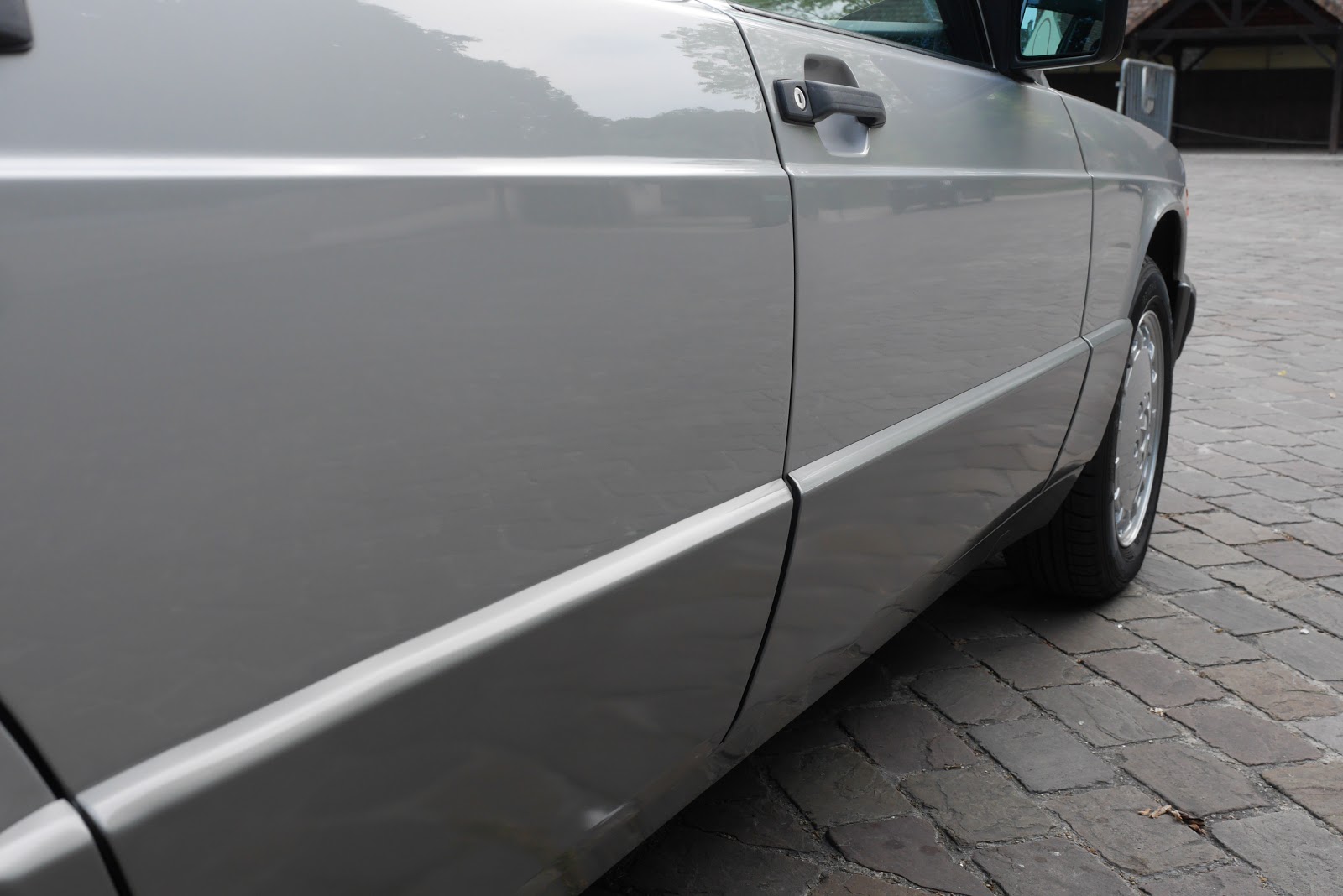
First impressions count for a lot with any car, and these Mercedes are no different. Stand back from the car and check for even panel gaps and a consistent paint colour and finish; if the car doesn’t look right, it may have suffered accident damage.

There is a big difference though between the W123 cars and the later 190 and W124 series. The W123 cars tend to suffer more from rust, especially on cars built until 1981, which used poorer-quality steel and had less rust protection applied when new. The W123 also had far more chrome trim – which adds to its appeal for many buyers now – but this can corrode, and some of these parts are costly to replace. Be wary of add-on chrome wheelarch trims (more popular in North America than in Europe), which can harbour rust.

Check along the side of the car for even
panel gaps and paintwork.
(Author's Collection)
 
Chrome side window trim adds to appeal
of C123 but is expensive to replace.
(Author's Collection)


The key spots to look at are the same across all the cars: look for rust around the wheelarches, on the wings and along the sills. One of the best guides to the condition of any Mercedes of this era is the jacking points. Remove the covers and look inside: if they are already rusting, it’s very likely that the sills will also be affected. Examine the edges of the front and rear screens, too, and on estate models the rearmost side window trims, for more traces of corrosion. Try and look underneath the car if you can, for signs of rust on the subframes and exhaust system.

The 190 and W124, especially in post-facelift guise, and on the 190 16-valve models, made more use of plastic body trim panels: these can crack or allow moisture to get in, with the result that corrosion can take hold on the metal panels underneath them.

A fine pickle! Severely corroded jacking point
and sill on 190. (Courtesy MTSV)
Rusting side window on S123 estate.
(Author's Collection)


Interior

With the huge mileages which all these Mercedes are capable of covering, it is by no means rare for unscrupulous sellers to wind back the mileage recorder. Ask yourself whether the overall condition of the interior matches the mileage shown: look at the condition of the driver’s seat bolster and for excessive wear on the steering wheel rim, gearlever and pedal rubbers. Check, too, for signs of damp on the seats, carpet or headlining, particularly on cars fitted with a sunroof, which can be a source of leaks.

Each of these series of Mercedes was offered with different types of upholstery: the legendary MB-Tex, a vinyl trim which is virtually indestructible, but can appear austere; leather, which is also hard-wearing; standard or – on the W124 and 190 – Sportline cloth, which can be vulnerable to soiling, especially in light colours; and velour, which was a luxury option in period and sets off cars such as the C123 coupés very well, but is less durable. Take note of any missing trim: some interior parts are now hard to find, especially in less popular colours.

Don’t forget to open the boot and check the condition of the spare wheel well. The boot floor is especially prone to rust on the 190.

Leather interior trim – seen here on a 
W123 250 saloon – is classy and
durable. (Author's Collection)
Rust is commonly found in the spare
wheel well on the 190. (Courtesy MTSV)

Electrics

Many fans of this era of Mercedes love the relative simplicity of their electrical systems. The older the car you are looking at, and often the lower down the model range you go, the fewer electrical accessories they tend to have. Many W123 models were delivered with manual windows, for example. In the W124 series, however, the top-end six- and eight-cylinder models often came fully equipped, so be sure to check that all the switches work as they should.

If the car you are considering is fitted with air-conditioning, has the system been overhauled and upgraded to use the current R134a refrigerant? If not, budget for an expensive service job.

Engine and mechanicals

Over the 20 years which these three series span, Mercedes fitted a huge number of different engines, but they generally have an excellent reputation. A quick look under the bonnet – which you can raise to a 90-degree service position for easier access – will often give you a good idea of how well the car has been looked after. Are there signs of oil or coolant leaks, loose hoses or corrosion under the battery, for example?

The naturally aspirated diesels, while slow by today’s standards, are some of the toughest engines ever built, easily capable of well over half a million miles.

The petrol units are not far behind, especially the mainstream four-cylinder models. Regular maintenance is essential though: on the M102 unit fitted to many models, this includes changing the simplex timing chain (fitted until 1987) every 60,000 miles. On the later six-cylinder W124 models, the engine wiring loom disintegrates over time and may need to be replaced.

Most of these cars used sophisticated but conventional suspensions, but the S123 and S124 estates, as well as the 190E 2.3-16 and 2.5-16, were originally fitted with self-levelling rear suspension. If the car sags at the rear or feels excessively hard, there may be fluid leaks in the system or problems with the pressure accumulators and pumps.

Remember to check the tyres: ideally these should be recent, with plenty of tread, and all from the same, reputable manufacturer. If the car you are considering is equipped with alloy wheels, are these free from corrosion and kerbing damage? If not, you may be able to cover the cost of refurbishing them when negotiating the price of the car.

With the bonnet in its service position,
access is easy. (Author's Collection)
If you can get underneath the car, check
for cracked springs and corrosion
on the suspension. (Courtesy MTSV)


Is restoration worthwhile?

For most of these cars, the answer today is probably not. The cost of a full-scale restoration, using high-quality OEM parts, will outweigh the value of the finished car. Unless you can afford a ‘money no object’ restoration to the exact specification you want, for most models it’s more sensible to keep looking, as there are enough cars out there.

The most sought-after models in each of these three series are, however, gradually increasing in value. The day may soon come when it does, in fact, make economic sense to restore a W123 series 280CE or 280TE or a 190E 2.3-16 or 2.5-16, for example.

 Completely stripped-down W123 bodyshell on display
at a classic car show in Germany. (Author's Collection)


Don't forget the paperwork

However good the car may look, having the right paperwork is essential. The VIN (Vehicle Identification Number) stamped on the car should match the number on the vehicle registration document. All Mercedes-Benz cars came with a data card, specifying the exact finish and equipment fitted; again, this should tally with the option codes stamped on the engine slam panel.

Finding a complete service history for a 40-year-old car may not always be possible, but evidence of recommissioning work after a period when the car has been laid up, or of recent service jobs, is all valuable. Make sure, too, that the car has a current MoT or similar roadworthiness certificate and note any ‘advisories’ indicating work which should be carried out.

VIN plate for a UK-market W123 250
automatic saloon. (Author's Collection)

Option codes plate for the author’s own
190E 2.6. (Author's Collection)

Find out more

Choosing and maintaining a modern classic from Mercedes is made all the easier thanks to the flourishing community of enthusiasts, parts suppliers and independent specialists catering to the marque. There are several newsstand magazines dedicated to Mercedes, all of which regularly feature the W123, W124 and 190, while the official Mercedes-Benz Clubs in the UK and USA are among the biggest and most professionally run single-marque car clubs.

If this feature has whetted your appetite to find out more about these great cars, why not take advantage of the special offer from Veloce Publishing on our Essential Buyer’s Guides, handy pocket-sized guides which tell you all you need to know about choosing and buying each of these models. Our latest guides cover each of the series described here, but in much more detail. 

If your mind is already set on the W123, Veloce also publishes the definitive guide to its history and development, from renowned motoring historian Brian Long.

There you have it – a round up of things to consider if you're looking to invest in a Mercedes-Benz. Along with those books mentioned by Julian, Brian Long has multiple other volumes charting the history of many other Mercedes series, and we also have Essential Buyer's Guides for 280-560SL & SLC, SL, and SLK, with one for the S-Class (another Julian Parish translation) set to publish in the spring.


About Julian Parish

Julian Parish is the author of six books for Veloce, including the Essential Buyer’s Guides to the Mercedes-Benz 190 and W123 series. A member of the Guild of Motoring Writers, he also translated the Essential Buyer’s Guide to the Mercedes-Benz W124 series from German into English. 

Julian lives in France, and as well as his automotive guides, he is the author of two popular travel guides, France: The Essential Guide for Car Enthusiasts, and The Essential Guide to Driving in Europe, and the Drive Guide Guru blog and website.


__________________________________________________________

All photos courtesy Mercedes-Benz Classic, except where otherwise shown.

__________________________________________________________


Monday, 7 January 2019

Choosing a modern classic from Mercedes with Julian Parish – Part one

Happy New Year to you all, and welcome to our first blog of 2019! 

As our very successful Essential Buyer's Guide series show (we've sold more than 175,000 copies worldwide!), here at Veloce we take buying a car very seriously, especially when it comes to classics – modern or otherwise. And if you're considering buying a Mercedes-Benz, then you're in the right place. Julian Parish, author of three Mercedes-Benz EBGs, and translator of a fourth, has written a practical two-part guide to help you decide which Mercedes is right for you – just keep reading for part one …


W123 and W124 part of a story of mid-sized saloons from Mercedes lasting 50 years.

Why choose Mercedes?

Whether it’s the latest S-Class saloon or a stylish ‘Pagoda’ SL from the Sixties, for many motorists there is nothing to match the prestige and sense of occasion that comes from driving a car with the three-pointed star. When it comes to Mercedes’ historic cars and even its so-called ‘modern classics’ built until the mid-1990s, the manufacturer’s engineering and build quality is unrivalled.

More than a quarter of a century later, its cars from the 1970s to mid-1990s can make a superb introduction to the pleasures of classic motoring: the Mercedes-Benz 190 (W201), W123 and W124 series – forerunners of the modern C and E-Class models – on which this blog focuses are among the most durable and reliable cars of their generation and can still be enjoyed today. 

The three series featured here include saloons, estates, coupés and convertibles, all with space for at least four passengers (we’ll leave the two-seater SL models for another time). If your partner or children are anxious about travelling in an older car, Mercedes was among the first manufacturers to invest massively in safety features, with anti-dive braking systems, deformable crumple zones and all-round seat belts, even on the earliest W123 models, which are now 40 years old. 

Many of these three series of cars are still available at surprisingly affordable prices (but don’t wait too long!). Parts availability is generally excellent, and service items at least are not too expensive. There is a wide choice of cars on sale and plenty of independent specialists to help keep your car running well. In the first half of this two-part blog, we’ll help you choose the right model. 

We even have a special offer to make the decision easier still!


Deciding which model is right for you

Which body style?

Like the W124 that followed it, the W123 was available in saloon, coupé and estate form.

Each of these three series of cars has its fans, so how should you decide which is right for you? Let’s begin with the body style:

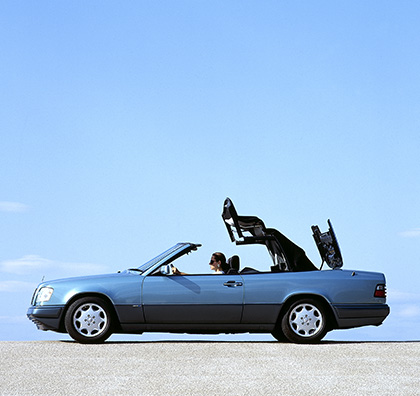
If open-air motoring with room for all the family is your priority, there is only one convertible available: the A124 model, introduced in autumn 1991 and available with a range of fuel-injected four- and six-cylinder petrol engines. The multi-layered hood ensures that the car can be driven in comfort throughout the year, while pop-up hoops behind the rear seats contribute to safety in the event of an accident. 


Electric folding hood on stylish A124 convertible.
If you are keen to enjoy one of Mercedes’ stylish two-door models but prefer a fixed roof (perhaps with the optional sunroof fitted to many cars), you can choose between the C123 and later C124 coupés. Both series have Mercedes’ famous pillarless styling, but the C123 stands out for its generous chrome trim. Make sure though that the horseshoe-shaped side window trim is in good condition: a replacement will run to nearly £1000! Most C123 coupés came in four-cylinder 230CE and six-cylinder 280CE form, but in North America, the coupé was also sold in diesel-engined 300CD spec, latterly with a turbo, to meet the Corporate Average Fuel Economy (CAFE) requirements there. The C124 models which followed are more modern to look at (which you may or may not prefer), but also have a more up-to-date feel on the road and increased power, especially in the case of the six-cylinder E320 models.


All these Mercedes coupés – from Stroke Eight (background) through C123 (centre) to C124 (foreground) had elegant, pillarless lines.

Not worried about the looks of a coupé or convertible, or in need of more space? Opting for a saloon gives you the biggest choice of all among Mercedes’ mid-sized modern classics: the 190 (W201), W123 and W124 series were all available as four-door saloons, with a huge range of diesel and petrol-engines, all the way up to the mighty 5-litre V8 fitted to the 500E/ E500. The mainstream models (particularly those with four-cylinder petrol engines) can be one of the most affordable ways of driving behind the three-pointed star, with all the quality and comfort of their two-door relatives but for less initial outlay. The 190 (aka the ‘Baby Benz’) is noticeably smaller than the other two series though, so make sure it’s roomy enough inside for your family.

190 saloon has least interior room, especially in the rear seats. (Courtesy Julian Parish)

None of Mercedes’ saloons from this era had folding rear seats, so if you need more luggage room, an estate is the obvious answer. The 190 was unique in that it was offered only as a four-door saloon, but there is plenty of choice to be found in the S123 and S124 models, with a wide range of petrol and diesel engines and, in both cases, an optional fold-out seat in the luggage compartment. This feature makes Mercedes’ estates one of the few classics able to carry a family of seven in comfort and safety and has helped drive up prices for these models today. Many of these estates have had a hard working life, so take your time if you are looking for a car in good condition with moderate mileage and a full history.


Fold-out seat in luggage compartment was available on both S123 and S124 estates.


Which engine?

Whichever Mercedes you decide on, nothing will affect the experience of driving it more than the engine you choose. 

Mercedes’ diesel engines, especially in naturally aspirated form, are among some of the longest-lived units ever produced, and have plenty of fans for their solid, imperturbable quality and moderate fuel consumption. But if you are buying a car now for high days and holidays, think carefully before choosing a diesel: the smaller four-cylinder versions especially are very slow by modern standards, developing as little as 55bhp in the W123 200D. More and more European cities are placing access restrictions on older diesels: that may not worry you now but could make it harder to sell on your car in a few years’ time.


Countless German taxi drivers relied on Mercedes’ long-lived diesels, such as this W123 in service in Stuttgart.

Most buyers today will probably opt for a petrol engine. The four-cylinder units are dependable and reasonably refined, although not particularly fast. Mercedes’ in-line sixes add more performance, but above all an extraordinarily smooth power delivery. Among the mainstream cars, the twin-cam engine fitted to the W123 280E and the 24-valve unit fitted to the W124 300E-24 are the sportiest powerplants, especially if mated to a five-speed manual transmission.


M102 four-cylinder petrol engine was fitted at different times to all three series in this feature.

If performance is your main goal, the selection is narrower, but choosing is certainly no hardship! Mercedes took the 190 into touring car racing with great success and produced an outstanding sports saloon in the form of the 190E 2.3-16, with its Cosworth-developed 16-valve engine and uprated suspension. Mercedes’ traditional customers may not have liked the bodykit and spoilers of the 2.3-16 and the larger-engined 2.5-16 which succeeded it, but it remains a compelling alternative to contemporary rivals such as BMW’s E30 M3.


Spoilers and bodykit fitted to 16-valve 190 models (here a 190E 2.5-16) were not to all buyers’ tastes.

With the larger W124 series, Mercedes took a different approach, shoehorning its 5-litre V8 under the bonnet of the 500E saloon and taking its performance to a different level altogether. Built with help from Porsche, this was a European muscle car with uprated handling to match its extra power. If the 500E is just a bit too much for you (or your wallet!), you may want to look for one of the rare six-cylinder E36 AMG models (available in the other body styles as well) or the 400E/E420 saloon with its 4.2-litre V8 and totally standard exterior appearance. This model was only sold in LHD, primarily for the North American market.


W124 E500 cornering fast on the test track.


Which transmission?

For decades, Mercedes had the reputation of building the best automatic transmissions in the business, offering the smoothest if not always the fastest changes. They are well suited to the refined character of the six-cylinder petrol engines or the torquey turbodiesels. In addition, the W123 and W124 series were fitted with a foot-operated parking brake, which many drivers find awkward for hill starts on cars fitted with manual transmission. There are no such worries with the 190, however, which has a conventional centre-mounted handbrake; the Getrag manual gearbox (with its unusual dogleg first) is a good match for the sporting 190E 2.3-16 and 2.5-16 models. 

All the Mercedes presented in this feature came with rear-wheel drive. If you regularly need to drive your Mercedes in wintry conditions but want a more luxurious all-rounder than the rugged G-Wagen, look out for one of the rare 4Matic saloons or estates, fitted with all-wheel drive. This transmission can be more expensive to maintain in later life, but a 300TE 4-Matic can make an interesting classic alternative to BMW’s 525iX and later cross-country estates from Audi and Volvo. 


Cutaway view of the 4Matic transmission offered on selected W124 models.


Which trim level and generation?


All three series of cars presented here hark back to the time before Mercedes introduced trim levels such as Avantgarde and Elegance, or the complex equipment packs it offers nowadays. Individual buyers chose the specific options they wanted, and there can be a huge difference between a basic ‘poverty-spec’ 190 or W123 200 saloon and a ‘fully-loaded’ late-model W124 E320 Coupé. The newer the car, the more equipment it is likely to have, but certain options – such as leather upholstery, a sunroof or period radio (usually from Becker) – will always add to a car’s appeal. 


Fully optioned 190E 2.3-16 with air conditioning, Becker stereo, four electric windows and heated front seats. (Courtesy Julian Parish)


Mercedes traditionally kept each of its models in production for many years (the R107 SL roadster lasted an astonishing 18 years!), with one or two facelifts along the way. In the case of the 190 and W124 series, for example, cars following the major facelift (in 1988 and 1989 respectively) can be recognised by the plastic cladding panels fitted to the lower side of the body. Mercedes also improved its cars on a continuous basis, with smaller cosmetic changes, enhanced standard equipment and even new engines being introduced between these major facelifts.

When buying now, it makes sense to buy on condition and history above all else. Be ready to settle for a different colour or forego a particular item of equipment if you find a car in the right condition. Even accepting a slightly different model or year of production may be the best decision. In general, though, cars in original specification are worth more than modified vehicles, unless the body or mechanical parts were fitted in period by top-end firms such as AMG or Brabus.


Late-model W124 saloon, with plastic side panels and Mercedes star on bonnet rather than grille.

Find out more

In the second part of this blog, we will introduce some of the main points to look for when choosing one of these Mercedes, covering in turn the exterior, interior and the engine and mechanical components. 


But if this feature has already whetted your appetite to find out more about these great cars, why not take advantage of our special Essential Buyer’s Guide offer? Get three guides – one for each of the models mentioned in this blog – for the price of just two, saving you £12.99.

You can find out more about each book and the special offer over on Julian's Drive Guide Guru website, and you can purchase direct from us.


If your mind is already set on the W123, we also publish the definitive guide to its history and development, from renowned motoring historian Brian Long.

About Julian Parish

Julian Parish is the author of six books for Veloce, including the Essential Buyer’s Guides to the Mercedes-Benz 190 and W123 series. A member of the Guild of Motoring Writers, he also translated the Essential Buyer’s Guide to the Mercedes-Benz W124 series from German into English. 

Julian lives in France, and as well as his automotive guides, he is the author of two popular travel guides, France: The Essential Guide for Car Enthusiasts, and The Essential Guide to Driving in Europe, and the Drive Guide Guru blog and website.

__________________________________________________________

All photos courtesy Mercedes-Benz Classic, except where otherwise shown.

__________________________________________________________