Last month saw the sad loss of another good friend of Veloce Publishing, and a true great from the world of motoring and auto journalism, Graham Robson, who died peacefully on 5 August at his home in Dorset.
Graham lived only a short drive along the coast from Veloce HQ, and was a frequent visitor throughout the year. With over 20 Veloce books to his name – and even an entire series in Rally Giants – Graham often popped-in to talk shop and answer questions about his latest work.
He was also equally inclined to pop in for a coffee and a catch-up, happy to chat about any and every subject from the latest engineering tech, to behind-the-scenes rally stories that only someone who was there could tell – as well as a myriad of things auto-related or otherwise. A dog lover with a soft spot for British Bulldogs, he was equally at home talking pups and pooches as he was pistons and prototypes.
Graham was a straight-talking Yorkshireman, and proud of it. He was also proud of his achievements, but never in a boastful way. With such a long and varied history, he had the remarkable ability to put his own achievements into context without hyperbole or ego creeping in. His directness and desire to get to the nitty-gritty of a subject is evident from his writing, and all Velocisti who had the pleasure to work with him could expect nothing less than utter professionalism and accuracy … with a rollicking good tale or two thrown in for good measure.
A welcome figure on the talking and eventing circuits, Graham was a regular up and down this country, and the USA, commentating, compering and presenting with a knowledge and humour that always made for engaging, enlightening and fun listening; he rapidly became a firm favourite with crowds and organisers alike. Our YouTube channel has a number of videos of Graham that are well worth a watch, including this great Author Profile, recorded in 2014.
His Veloce books hint at just how broad his knowledge was, covering everything from the technicalities of groundbreaking Rally cars, to the global commercial pressures that shaped empire-building brands. He was a member of the Guild of Motoring Writers, the winner of many national and international awards and the author of nearly 170 books. His personal experiences of the people, places, and races that have become landmarks in automotive history meant he could talk with an authority unmatched by many writers.
Graham will be sorely missed by all the Velocisti. What better way to celebrate Graham's life and work than with his Veloce titles, from his first Veloce book in 1998, Cortina: The Story of Ford’s Best Seller, to his soon-to-be published Classic Reprint edition of The Cars of BMC.
The complete history of these ultimate driving machines
Fully updated, highly detailed, this brand-new edition of Graham Robson’s original Haynes publication explores every aspect of BMW M3 history, including its motorsport success worldwide. From the original E30 of 1986, through E36, E46, and E90 to the 6th gen of 2020, and the M4, it includes full, detailed specifications for each generation, and brings the M3 story right up to the present day, covering all models produced between 2013 and 2021, including M4.
The definitive history of the hugely successful model which stayed in production for five generations, enjoyed great success in motor racing and rallying and which redefined the family car. With over 180 colour and black and white photos this is the fascinating story of a incredibly successful car.
SKU V5100P • Paperback or eBook • 20.7x25cm • 160 pages • pictures • Flowing format eBook
Cosworth
The Search for Power (6th Edition)
This book covers the entire history, life and times of the famous British high-performance engineering company, from its 1958 foundation by Mike Costin and Keith Duckworth, through its often-exciting and always fascinating evolution, to its expansion and worldwide success in both motorsport and high-performance road cars.
The story of the 97 Ford Focus WRC cars during their 12-year rallying career; there were 44 World Championship victories, and the team won the World Rally Manufacturers’ Championship. Drivers included Colin McRae, Carlos Sainz, Marcus Grönholm and Mikko Hirvonen, with sponsors including Martini, BP (and Castrol), and the state of Abu Dhabi.
In 1965, Colin Chapman persuaded Ford to underwrite development of a V8 for the new 3000cc Grand Prix formula. Built by Cosworth, the new DFV engine won Lotus four World Championship Grands Prix in 1967. A year later, and now available to other constructors, the engine began its domination of Grand Prix racing. This important book is illustrated with more than 300 photographs, most of which come from the UK Ford Motor Company’s own archives.
Starting with the original Standard prototype of 1903, this book covers the scores of Standard models built until the brand was discontinued in 1963 (Britain) and 1987 (India). It also covers the Ferguson tractor involvement, millitary aero-engine manufacture, military aircraft manufacturer (including Beaufighter and Mosquito fighter-bombers), Rolls-Royce Avon turbo-jet military engine manufacture, and Triumph cars. This is the first definitive book to cover this major British marque.
The Cars of BMC is the most detailed record of the origins, operations, and legacy of one of Britain's most historically important industrial concerns. This is a unique record from one of the most respected automotive historians, and a key player in the British automotive industry. This new edition of The Cars of BMC covers the cars of the period 1945 to 1975, and the following marques: Austin; Austin-Healey; Innocenti; Metropolitan; MG; Morris; Riley; Vanden Plas; Wolseley; British Motor Holdsin (BMH) and British Leyland, plus subsidiaries and overseas connections.
Lasting six weeks and covering 16,000 miles from London to Mexico City via some of the most varying, tortuous and difficult terrain on three continents, the 1970 World Cup Rally was a unique high-speed event. Attracting many serious works teams such as Ford and British Leyland, it was, and remains, the toughest rally of all time. This book, now reprinted in paperback, tells the complete story.
SKU V5228P • Paperback or eBook • 22.5x22.5cm • 208 pages • 237 pictures • Flowing format eBook
The Great British Rally
RAC to Rally GB - The Complete Story
From the running of the 1932 RAC rally, mainly a social event, to the present day, when Rally GB is a high-speed endurance World Championship rally, this is the very first all-embracing history of an important part of British motorsport history. Descriptions of every event, opinions, and results are brought together for the very first time, with year-by-year accounts of all events in the Rally’s history, and copiously illustrated with period photographs. It also covers the many and varied challenges posed by such crises as foot and mouth disease, weather conditions, and controversy over rules and regulations: this book is truly the definitive guide.
The distinguished 130-year history of the Triumph company from original pedal cycles, to the first Triumph cars, and then every model up to the end of production. The authors reveal the in-house politics of the company, its design and engineering achievements, competition activities, and its international sales and marketing success.
The Audi Quattro is a Rally Giant because it was the first to combine four-wheel-drive and a turbocharged engine – not the most sophisticated, but it was the first, and very successful. It was also the first to run with more than 300bhp. As it was re-homologated/transformed from Group 4 into Group B in 1983, it was also the first successful Group B car.
SKU V5110P • Paperback or eBook • 21x19.5cm • 128 pages • 116 pictures • Flowing format eBook
Austin Healey 100-6 & 3000
Between 1957 and 1965 the six-cylinder-engined Austin Healey evolved into a formidable and increasingly specialised rally car. By any standards, it was the first of the ‘homologation specials’ – a type made progressively stronger, faster, more versatile, and more suitable for the world’s toughest international rallies. This book tells its story.
SKU V5324P • Paperback or eBook • 21x19.5cm • 128 pages • 140 pictures • Flowing format eBook
Fiat 131 Abarth
Fiat entered rallying in 1970, with the aim of becoming World Rally Champion – and it was the 131 Abarth of 1976-1980 which made that possible. It soon began winning World rallies, and, in 1977, 1978 and 1980, the 'works' team also won the World Championship for Makes, paving the way for successors the Lancia Rally 037 and the Delta Integrale.
SKU V5111P • Paperback or eBook • 21x19.5cm • 128 pages • 100 pictures • Flowing format eBook
Ford Escort Mk1
The story of the Ford Escort MkI, a car that delivered everything its predecessor, the Lotus-Cortina, had promised. Versatile, accessible and competitive at all levels, it dominated international rallying throughout the 1970s, and became hugely popular with teams and spectators alike.
SKU V5107P • Paperback or eBook • 21x19.5cm • 128 pages • 107 pictures • Flowing format eBook
Ford Escort RS Cosworth & World Rally Car
The Escort RS Cosworth became Ford's most successful model since the legendary Escorts of the 1970s. The combination of Cosworth power, 4WD transmission, and an effective aerodynamic package made it a Rally Giant in all conditions, making this generation of Escorts the most effective rally car that Ford had produced at that time.
The Ford Escort MkII, the RS1800, became Ford’s most successful rally car, and is still winning historic events today. It brought new standards to the sport, inspiring many others to copy it. This books contains full details of every ‘works’ Escort MkII that went rallying, plus driver and personality profiles, and detailed car evolution.
SKU V5109P • Paperback or eBook • 21x19.5cm • 128 pages • 112 pictures • Flowing format eBook
Lancia Delta 4WD/Integrale
The HF 4WD – a compact, five-door Lancia – dominated world-class rallying for six years, winning innumerable events, World Championships for Drivers, and World Championships for Manufacturers. Alongside the cars, driving heroes such as Markku Alan, Didier Auriol, Miki Biasion, Juha Kankkunen and Carlos Sainz also became legendary in this period.
This book describes the birth, development and rallying career of the Lancia Stratos, Europe’s very first purpose-built rally car, in the mid/late 1970s. It provides a compact and authoritative history of where, when and how it became so important to the sport, as well as telling the story of the team.
SKU V5526P • Paperback or eBook • 21x19.5cm • 128 pages • 131 pictures • Flowing format eBook
Mini Cooper/Mini Cooper S
This book describes the birth, development, and rallying career of the BMC Mini-Cooper/Mini-Cooper in the 1960s, providing a compact and authoritative history of where, when and how it became so important to the sport. Even today, works Minis appear at every gathering of classic cars – and in 2009, Mini celebrates its 50th birthday. Packed with over 100 photographs, this book is a fitting and timely tribute to a much-loved Rally Giant.
Peugeot designed, developed, campaigned and won with the first truly sophisticated four-wheel-drive Group B Car – the 205 Turbo 16. Detailing the cars, the influences, and the personalities behind a magnificent success story, this book is packed with illustrations, and technical data on this innovative car, and is a must for any rally fan.
SKU V5325P • Paperback or eBook • 21x19.5cm • 128 pages • 100 pictures • Flowing format eBook
Saab 96 & V4
The story of the front-wheel-drive Saab 96, which made the brand into a rally icon in the 1960s. It succeeded in events as diverse as the Monte Carlo, Britain's RAC Rally, many Scandinavian events, and the Spa-Sofia-Liége Marathon. The 96 and V4 models produced victory where no-one expected it.
SKU V5332P • Paperback or eBook • 21x19.5cm • 128 pages • 135 pictures • Flowing format eBook
Subaru Impreza
This book describes the birth, development, and rallying car of the turbocharged, four-wheel-drive Subaru Impreza in the 1990s and early 2000s, providing a compact and authoritative history of where, when and how it became so important to the sport.
SKU V5322P • Paperback or eBook • 21x19.5cm • 128 pages • 96 pictures • Flowing format eBook
Toyota Celica GT-Four
This book describes the birth, development, and rallying career of the Toyota Celica GT-Four, providing a compact and authoritative history of where, when and how it became so important to the sport.
Welcome to part two of Julian Parish's guide to choosing a modern classic from Mercedes. A member of the Guild of Motoring Writers and a Mercedes enthusiast, Julian has all the knowledge needed to give a practical overview of which Mercedes will be right for you. If you need to catch up with part one, you can find it here. Now, on to part two:
W123 and W124 part of a story of mid-sized saloons from Mercedes lasting 50 years.
Getting started
In the first half of this two-part blog, we looked at three series of Mercedes’ mid-sized cars from the 1970s to mid-1990s: the Mercedes-Benz190 (W201), W123 and W124 series. These were the forerunners of the modern C and E-Class models and any of them can make a superb introduction to the pleasures of classic motoring.
Now, though, it is time to look more closely at some of the most common problems you may find, and what to look out for when buying. We’ll also tell you about where to find out more and even have a special offer to make the decision easier still!
New 190, with larger, but more traditionally
styled W123 saloon beside it.
Once you’ve narrowed down at least the series of car you want to consider, what should you look out for? Take your time and aim to see a good range of cars: even poor examples will help you learn more about what to watch out for. However impressive the engineering, the oldest of these cars have been on the road for more than 40 years and many will have covered high mileages – plenty of time for problems to set in, especially if previous owners have skimped on regular maintenance. So inspect each car carefully and be sure to ask for a test drive – something to which no serious seller should object.
It is hard to believe that this 190E has covered nearly 200,000 miles.
Exterior
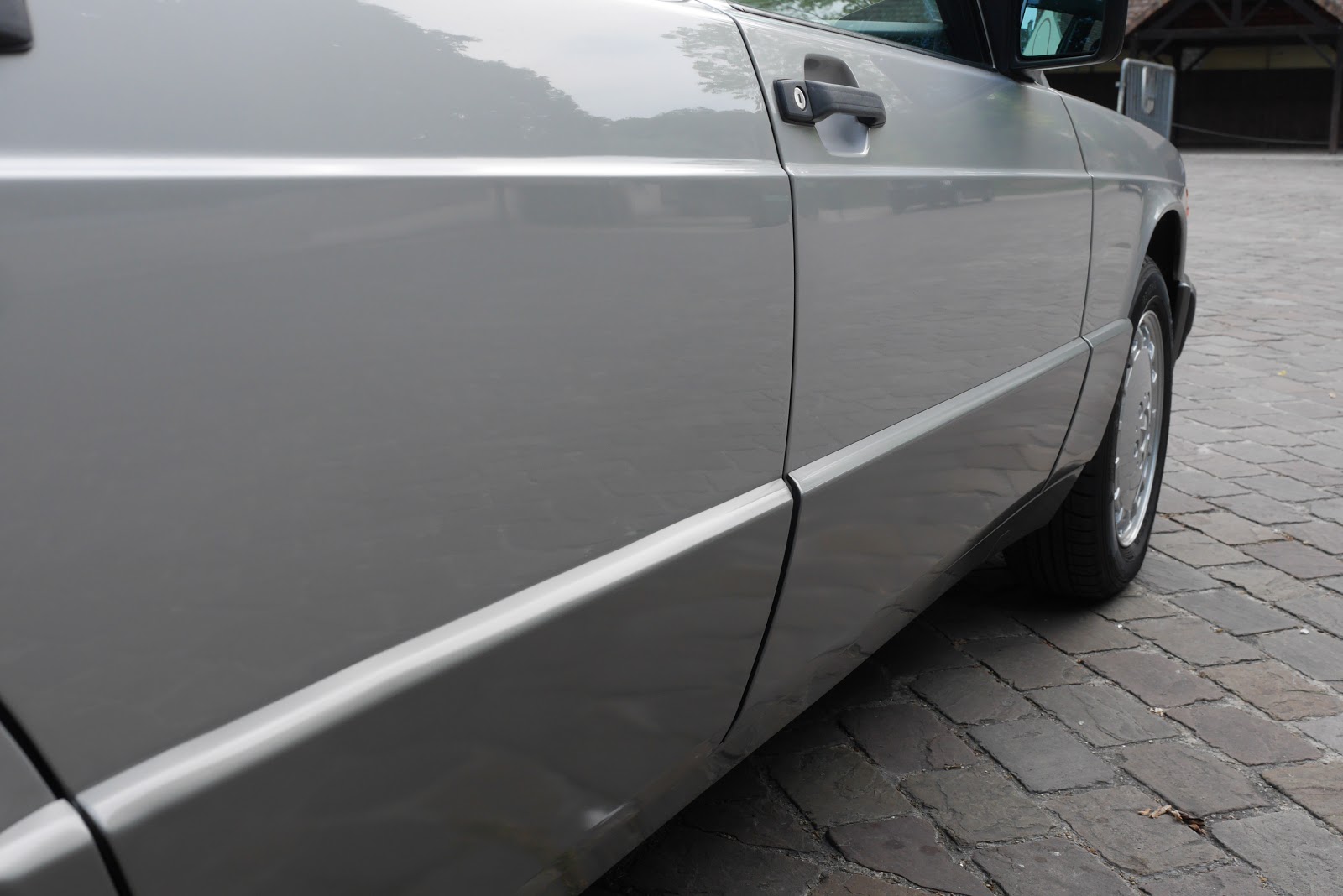
First impressions count for a lot with any car, and these Mercedes are no different. Stand back from the car and check for even panel gaps and a consistent paint colour and finish; if the car doesn’t look right, it may have suffered accident damage.
There is a big difference though between the W123 cars and the later 190 and W124 series. The W123 cars tend to suffer more from rust, especially on cars built until 1981, which used poorer-quality steel and had less rust protection applied when new. The W123 also had far more chrome trim – which adds to its appeal for many buyers now – but this can corrode, and some of these parts are costly to replace. Be wary of add-on chrome wheelarch trims (more popular in North America than in Europe), which can harbour rust.
Check along the side of the car for even
panel gaps and paintwork.
(Author's Collection)
Chrome side window trim adds to appeal
of C123 but is expensive to replace.
(Author's Collection)
The key spots to look at are the same across all the cars: look for rust around the wheelarches, on the wings and along the sills. One of the best guides to the condition of any Mercedes of this era is the jacking points. Remove the covers and look inside: if they are already rusting, it’s very likely that the sills will also be affected. Examine the edges of the front and rear screens, too, and on estate models the rearmost side window trims, for more traces of corrosion. Try and look underneath the car if you can, for signs of rust on the subframes and exhaust system.
The 190 and W124, especially in post-facelift guise, and on the 190 16-valve models, made more use of plastic body trim panels: these can crack or allow moisture to get in, with the result that corrosion can take hold on the metal panels underneath them.
A fine pickle! Severely corroded jacking point
and sill on 190. (Courtesy MTSV)
Rusting side window on S123 estate.
(Author's Collection)
Interior
With the huge mileages which all these Mercedes are capable of covering, it is by no means rare for unscrupulous sellers to wind back the mileage recorder. Ask yourself whether the overall condition of the interior matches the mileage shown: look at the condition of the driver’s seat bolster and for excessive wear on the steering wheel rim, gearlever and pedal rubbers. Check, too, for signs of damp on the seats, carpet or headlining, particularly on cars fitted with a sunroof, which can be a source of leaks.
Each of these series of Mercedes was offered with different types of upholstery: the legendary MB-Tex, a vinyl trim which is virtually indestructible, but can appear austere; leather, which is also hard-wearing; standard or – on the W124 and 190 – Sportline cloth, which can be vulnerable to soiling, especially in light colours; and velour, which was a luxury option in period and sets off cars such as the C123 coupés very well, but is less durable. Take note of any missing trim: some interior parts are now hard to find, especially in less popular colours.
Don’t forget to open the boot and check the condition of the spare wheel well. The boot floor is especially prone to rust on the 190.
Leather interior trim – seen here on a W123 250 saloon – is classy and durable. (Author's Collection)
Rust is commonly found in the spare
wheel well on the 190. (Courtesy MTSV)
Electrics
Many fans of this era of Mercedes love the relative simplicity of their electrical systems. The older the car you are looking at, and often the lower down the model range you go, the fewer electrical accessories they tend to have. Many W123 models were delivered with manual windows, for example. In the W124 series, however, the top-end six- and eight-cylinder models often came fully equipped, so be sure to check that all the switches work as they should.
If the car you are considering is fitted with air-conditioning, has the system been overhauled and upgraded to use the current R134a refrigerant? If not, budget for an expensive service job.
Engine and mechanicals
Over the 20 years which these three series span, Mercedes fitted a huge number of different engines, but they generally have an excellent reputation. A quick look under the bonnet – which you can raise to a 90-degree service position for easier access – will often give you a good idea of how well the car has been looked after. Are there signs of oil or coolant leaks, loose hoses or corrosion under the battery, for example?
The naturally aspirated diesels, while slow by today’s standards, are some of the toughest engines ever built, easily capable of well over half a million miles.
The petrol units are not far behind, especially the mainstream four-cylinder models. Regular maintenance is essential though: on the M102 unit fitted to many models, this includes changing the simplex timing chain (fitted until 1987) every 60,000 miles. On the later six-cylinder W124 models, the engine wiring loom disintegrates over time and may need to be replaced.
Most of these cars used sophisticated but conventional suspensions, but the S123 and S124 estates, as well as the 190E 2.3-16 and 2.5-16, were originally fitted with self-levelling rear suspension. If the car sags at the rear or feels excessively hard, there may be fluid leaks in the system or problems with the pressure accumulators and pumps.
Remember to check the tyres: ideally these should be recent, with plenty of tread, and all from the same, reputable manufacturer. If the car you are considering is equipped with alloy wheels, are these free from corrosion and kerbing damage? If not, you may be able to cover the cost of refurbishing them when negotiating the price of the car.
With the bonnet in its service position,
access is easy. (Author's Collection)
If you can get underneath the car, check
for cracked springs and corrosion
on the suspension. (Courtesy MTSV)
Is restoration worthwhile?
For most of these cars, the answer today is probably not. The cost of a full-scale restoration, using high-quality OEM parts, will outweigh the value of the finished car. Unless you can afford a ‘money no object’ restoration to the exact specification you want, for most models it’s more sensible to keep looking, as there are enough cars out there.
The most sought-after models in each of these three series are, however, gradually increasing in value. The day may soon come when it does, in fact, make economic sense to restore a W123 series 280CE or 280TE or a 190E 2.3-16 or 2.5-16, for example.
Completely stripped-down W123 bodyshell on display
at a classic car show in Germany. (Author's Collection)
Don't forget the paperwork
However good the car may look, having the right paperwork is essential. The VIN (Vehicle Identification Number) stamped on the car should match the number on the vehicle registration document. All Mercedes-Benz cars came with a data card, specifying the exact finish and equipment fitted; again, this should tally with the option codes stamped on the engine slam panel.
Finding a complete service history for a 40-year-old car may not always be possible, but evidence of recommissioning work after a period when the car has been laid up, or of recent service jobs, is all valuable. Make sure, too, that the car has a current MoT or similar roadworthiness certificate and note any ‘advisories’ indicating work which should be carried out.
VIN plate for a UK-market W123 250
automatic saloon. (Author's Collection)
Option codes plate for the author’s own
190E 2.6. (Author's Collection)
Find out more
Choosing and maintaining a modern classic from Mercedes is made all the easier thanks to the flourishing community of enthusiasts, parts suppliers and independent specialists catering to the marque. There are several newsstand magazines dedicated to Mercedes, all of which regularly feature the W123, W124 and 190, while the official Mercedes-Benz Clubs in the UK and USA are among the biggest and most professionally run single-marque car clubs.
If this feature has whetted your appetite to find out more about these great cars, why not take advantage of the special offerfrom Veloce Publishing on our Essential Buyer’s Guides, handy pocket-sized guides which tell you all you need to know about choosing and buying each of these models. Our latest guides cover each of the series described here, but in much more detail.
If your mind is already set on the W123, Veloce also publishes the definitive guide to its history and development, from renowned motoring historian Brian Long.
There you have it – a round up of things to consider if you're looking to invest in a Mercedes-Benz. Along with those books mentioned by Julian, Brian Long has multiple other volumes charting the history of many other Mercedes series, and we also have Essential Buyer's Guides for 280-560SL & SLC, SL, and SLK, with one for the S-Class (another Julian Parish translation) set to publish in the spring.
About Julian Parish
Julian Parish is the author of six books for Veloce, including the Essential Buyer’s Guides to the Mercedes-Benz 190 and W123 series. A member of the Guild of Motoring Writers, he also translated the Essential Buyer’s Guide to the Mercedes-Benz W124 series from German into English.
Happy New Year to you all, and welcome to our first blog of 2019!
As our very successful Essential Buyer's Guide series show (we've sold more than 175,000 copies worldwide!), here at Veloce we take buying a car very seriously, especially when it comes to classics – modern or otherwise. And if you're considering buying a Mercedes-Benz, then you're in the right place. Julian Parish, author of three Mercedes-Benz EBGs, and translator of a fourth, has written a practical two-part guide to help you decide which Mercedes is right for you – just keep reading for part one …
W123 and W124 part of a story of mid-sized saloons from Mercedes lasting 50 years.
Why choose Mercedes?
Whether it’s the latest S-Class saloon or a stylish ‘Pagoda’ SL from the Sixties, for many motorists there is nothing to match the prestige and sense of occasion that comes from driving a car with the three-pointed star. When it comes to Mercedes’ historic cars and even its so-called ‘modern classics’ built until the mid-1990s, the manufacturer’s engineering and build quality is unrivalled. More than a quarter of a century later, its cars from the 1970s to mid-1990s can make a superb introduction to the pleasures of classic motoring: the Mercedes-Benz 190 (W201), W123 and W124 series – forerunners of the modern C and E-Class models – on which this blog focuses are among the most durable and reliable cars of their generation and can still be enjoyed today. The three series featured here include saloons, estates, coupés and convertibles, all with space for at least four passengers (we’ll leave the two-seater SL models for another time). If your partner or children are anxious about travelling in an older car, Mercedes was among the first manufacturers to invest massively in safety features, with anti-dive braking systems, deformable crumple zones and all-round seat belts, even on the earliest W123 models, which are now 40 years old. Many of these three series of cars are still available at surprisingly affordable prices (but don’t wait too long!). Parts availability is generally excellent, and service items at least are not too expensive. There is a wide choice of cars on sale and plenty of independent specialists to help keep your car running well. In the first half of this two-part blog, we’ll help you choose the right model. We even have a special offer to make the decision easier still!
Deciding which model is right for you
Which body style?
Like the W124 that followed it, the W123 was available in saloon, coupé and estate form.
Each of these three series of cars has its fans, so how should you decide which is right for you? Let’s begin with the body style:
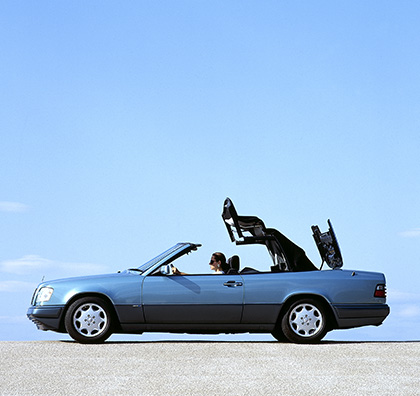
If open-air motoring with room for all the family is your priority, there is only one convertible available: the A124 model, introduced in autumn 1991 and available with a range of fuel-injected four- and six-cylinder petrol engines. The multi-layered hood ensures that the car can be driven in comfort throughout the year, while pop-up hoops behind the rear seats contribute to safety in the event of an accident.
Electric folding hood on stylish A124 convertible.
If you are keen to enjoy one of Mercedes’ stylish two-door models but prefer a fixed roof (perhaps with the optional sunroof fitted to many cars), you can choose between the C123 and later C124 coupés. Both series have Mercedes’ famous pillarless styling, but the C123 stands out for its generous chrome trim. Make sure though that the horseshoe-shaped side window trim is in good condition: a replacement will run to nearly £1000! Most C123 coupés came in four-cylinder 230CE and six-cylinder 280CE form, but in North America, the coupé was also sold in diesel-engined 300CD spec, latterly with a turbo, to meet the Corporate Average Fuel Economy (CAFE) requirements there. The C124 models which followed are more modern to look at (which you may or may not prefer), but also have a more up-to-date feel on the road and increased power, especially in the case of the six-cylinder E320 models.
All these Mercedes coupés – from Stroke Eight (background) through C123 (centre) to C124 (foreground) had elegant, pillarless lines.
Not worried about the looks of a coupé or convertible, or in need of more space? Opting for a saloon gives you the biggest choice of all among Mercedes’ mid-sized modern classics: the 190 (W201), W123 and W124 series were all available as four-door saloons, with a huge range of diesel and petrol-engines, all the way up to the mighty 5-litre V8 fitted to the 500E/ E500. The mainstream models (particularly those with four-cylinder petrol engines) can be one of the most affordable ways of driving behind the three-pointed star, with all the quality and comfort of their two-door relatives but for less initial outlay. The 190 (aka the ‘Baby Benz’) is noticeably smaller than the other two series though, so make sure it’s roomy enough inside for your family.
190 saloon has least interior room, especially in the rear seats. (Courtesy Julian Parish)
None of Mercedes’ saloons from this era had folding rear seats, so if you need more luggage room, an estate is the obvious answer. The 190 was unique in that it was offered only as a four-door saloon, but there is plenty of choice to be found in the S123 and S124 models, with a wide range of petrol and diesel engines and, in both cases, an optional fold-out seat in the luggage compartment. This feature makes Mercedes’ estates one of the few classics able to carry a family of seven in comfort and safety and has helped drive up prices for these models today. Many of these estates have had a hard working life, so take your time if you are looking for a car in good condition with moderate mileage and a full history.
Fold-out seat in luggage compartment was available on both S123 and S124 estates.
Which engine?
Whichever Mercedes you decide on, nothing will affect the experience of driving it more than the engine you choose. Mercedes’ diesel engines, especially in naturally aspirated form, are among some of the longest-lived units ever produced, and have plenty of fans for their solid, imperturbable quality and moderate fuel consumption. But if you are buying a car now for high days and holidays, think carefully before choosing a diesel: the smaller four-cylinder versions especially are very slow by modern standards, developing as little as 55bhp in the W123 200D. More and more European cities are placing access restrictions on older diesels: that may not worry you now but could make it harder to sell on your car in a few years’ time.
Countless German taxi drivers relied on Mercedes’ long-lived diesels, such as this W123 in service in Stuttgart.
Most buyers today will probably opt for a petrol engine. The four-cylinder units are dependable and reasonably refined, although not particularly fast. Mercedes’ in-line sixes add more performance, but above all an extraordinarily smooth power delivery. Among the mainstream cars, the twin-cam engine fitted to the W123 280E and the 24-valve unit fitted to the W124 300E-24 are the sportiest powerplants, especially if mated to a five-speed manual transmission.
M102 four-cylinder petrol engine was fitted at different times to all three series in this feature.
If performance is your main goal, the selection is narrower, but choosing is certainly no hardship! Mercedes took the 190 into touring car racing with great success and produced an outstanding sports saloon in the form of the 190E 2.3-16, with its Cosworth-developed 16-valve engine and uprated suspension. Mercedes’ traditional customers may not have liked the bodykit and spoilers of the 2.3-16 and the larger-engined 2.5-16 which succeeded it, but it remains a compelling alternative to contemporary rivals such as BMW’s E30 M3.
Spoilers and bodykit fitted to 16-valve 190 models (here a 190E 2.5-16) were not to all buyers’ tastes.
With the larger W124 series, Mercedes took a different approach, shoehorning its 5-litre V8 under the bonnet of the 500E saloon and taking its performance to a different level altogether. Built with help from Porsche, this was a European muscle car with uprated handling to match its extra power. If the 500E is just a bit too much for you (or your wallet!), you may want to look for one of the rare six-cylinder E36 AMG models (available in the other body styles as well) or the 400E/E420 saloon with its 4.2-litre V8 and totally standard exterior appearance. This model was only sold in LHD, primarily for the North American market.
W124 E500 cornering fast on the test track.
Which transmission?
For decades, Mercedes had the reputation of building the best automatic transmissions in the business, offering the smoothest if not always the fastest changes. They are well suited to the refined character of the six-cylinder petrol engines or the torquey turbodiesels. In addition, the W123 and W124 series were fitted with a foot-operated parking brake, which many drivers find awkward for hill starts on cars fitted with manual transmission. There are no such worries with the 190, however, which has a conventional centre-mounted handbrake; the Getrag manual gearbox (with its unusual dogleg first) is a good match for the sporting 190E 2.3-16 and 2.5-16 models. All the Mercedes presented in this feature came with rear-wheel drive. If you regularly need to drive your Mercedes in wintry conditions but want a more luxurious all-rounder than the rugged G-Wagen, look out for one of the rare 4Matic saloons or estates, fitted with all-wheel drive. This transmission can be more expensive to maintain in later life, but a 300TE 4-Matic can make an interesting classic alternative to BMW’s 525iX and later cross-country estates from Audi and Volvo.
Cutaway view of the 4Matic transmission offered on selected W124 models.
Which trim level and generation?
All three series of cars presented here hark back to the time before Mercedes introduced trim levels such as Avantgarde and Elegance, or the complex equipment packs it offers nowadays. Individual buyers chose the specific options they wanted, and there can be a huge difference between a basic ‘poverty-spec’ 190 or W123 200 saloon and a ‘fully-loaded’ late-model W124 E320 Coupé. The newer the car, the more equipment it is likely to have, but certain options – such as leather upholstery, a sunroof or period radio (usually from Becker) – will always add to a car’s appeal.
Fully optioned 190E 2.3-16 with air conditioning, Becker stereo, four electric windows and heated front seats. (Courtesy Julian Parish)
Mercedes traditionally kept each of its models in production for many years (the R107 SL roadster lasted an astonishing 18 years!), with one or two facelifts along the way. In the case of the 190 and W124 series, for example, cars following the major facelift (in 1988 and 1989 respectively) can be recognised by the plastic cladding panels fitted to the lower side of the body. Mercedes also improved its cars on a continuous basis, with smaller cosmetic changes, enhanced standard equipment and even new engines being introduced between these major facelifts. When buying now, it makes sense to buy on condition and history above all else. Be ready to settle for a different colour or forego a particular item of equipment if you find a car in the right condition. Even accepting a slightly different model or year of production may be the best decision. In general, though, cars in original specification are worth more than modified vehicles, unless the body or mechanical parts were fitted in period by top-end firms such as AMG or Brabus.
Late-model W124 saloon, with plastic side panels and Mercedes star on bonnet rather than grille.
Find out more
In the second part of this blog, we will introduce some of the main points to look for when choosing one of these Mercedes, covering in turn the exterior, interior and the engine and mechanical components. But if this feature has already whetted your appetite to find out more about these great cars, why not take advantage of our special Essential Buyer’s Guide offer? Get three guides – one for each of the models mentioned in this blog – for the price of just two, saving you £12.99.
Julian Parish is the author of six books for Veloce, including the Essential Buyer’s Guides to the Mercedes-Benz 190 and W123 series. A member of the Guild of Motoring Writers, he also translated the Essential Buyer’s Guide to the Mercedes-Benz W124 series from German into English.






 Posts
Posts

