Showing posts with label essential buyer's guide. Show all posts

Thursday, 2 April 2020

Bigger and better pocket experts


15 years ago, we had an idea. Imagine if there was a handy pocket-sized guide that explained all you needed to look for when buying a car or bike? What if it could cover classic, vintage, and modern cars … and motorcycles? And written by someone with personal experience and expertise on the vehicle? Would people want such a thing? 

From a simple idea, to over
175,000 books sold
Fast forward to the present day, and the answer is a resounding "Yes!" We created the Essential Buyer's Guide series – or EBGs to us Velocisti – to fulfil all of the above criteria, and the resulting books have become one of our flagship series. 

Covering 106 models of car, 25 models of motorcycle, and even electric bicycles, these invaluable pocket-sized guides have been helping people buy their dream drive or ride ever since, and have now sold over 175,000 copies, with more models added constantly.

Our first ever EBG …
We know that cramming so much useful stuff into a convenient format is a tad tricky. Describing or illustrating often crowded or hard-to-discern areas of a vehicle's construction can be hard with small images.

From our first EBG for the Alfa Romeo Guilia Spider, to our newest batch, every book is crammed with information that's truly essential for a sound purchase. Because each is written by an expert on the marque or model covered, there's genuine 'insider information' within, which also makes them ideal reference books for enthusiasts and workshop tinkerers alike. 
… and our latest.


Recently, we decided to make all our new EBGs a little bigger, with 96 pages, instead of the original 64. With more pages, we have space for larger, clearer photos and illustrations. There's also a page for notes, should you be taking your guide with you on your vehicle hunt (which you should, of course), and need to scribble down a few details. 

Existing EBGs will retain their current 64 page format, although some may get an updated 'makeover' to the new format. For digital natives out there (you know who you are), we also have a selection of EBG apps for iOS and Android: check out our apps on the website, and see if we've something for your dream drive. 

We're continually adding to the series, and that's where YOU could help us. We're always on the lookout for a guide that fits a need, so if there's a particular model or marque that you'd like to see covered, or if you have the knowledge and experience to pen one for a particular vehicle, get in touch: we may be able to bring your idea to fruition … just as we did 15 years ago, with our idea for the Essential Buyer's Guides.

Tuesday, 15 January 2019

Choosing a modern classic from Mercedes with Julian Parish – Part two

Welcome to part two of Julian Parish's guide to choosing a modern classic from Mercedes. A member of the Guild of Motoring Writers and a Mercedes enthusiast, Julian has all the knowledge needed to give a practical overview of which Mercedes will be right for you. If you need to catch up with part one, you can find it here. Now, on to part two:

W123 and W124 part of a story of mid-sized saloons from Mercedes lasting 50 years.

Getting started

In the first half of this two-part blog, we looked at three series of Mercedes’ mid-sized cars from the 1970s to mid-1990s: the Mercedes-Benz190 (W201), W123 and W124 series. These were the forerunners of the modern C and E-Class models and any of them can make a superb introduction to the pleasures of classic motoring. 

Now, though, it is time to look more closely at some of the most common problems you may find, and what to look out for when buying. We’ll also tell you about where to find out more and even have a special offer to make the decision easier still!

New 190, with larger, but more traditionally
styled W123 saloon beside it.
Once you’ve narrowed down at least the series of car you want to consider, what should you look out for? Take your time and aim to see a good range of cars: even poor examples will help you learn more about what to watch out for. However impressive the engineering, the oldest of these cars have been on the road for more than 40 years and many will have covered high mileages – plenty of time for problems to set in, especially if previous owners have skimped on regular maintenance. So inspect each car carefully and be sure to ask for a test drive – something to which no serious seller should object.

It is hard to believe that this 190E has covered nearly 200,000 miles.

Exterior

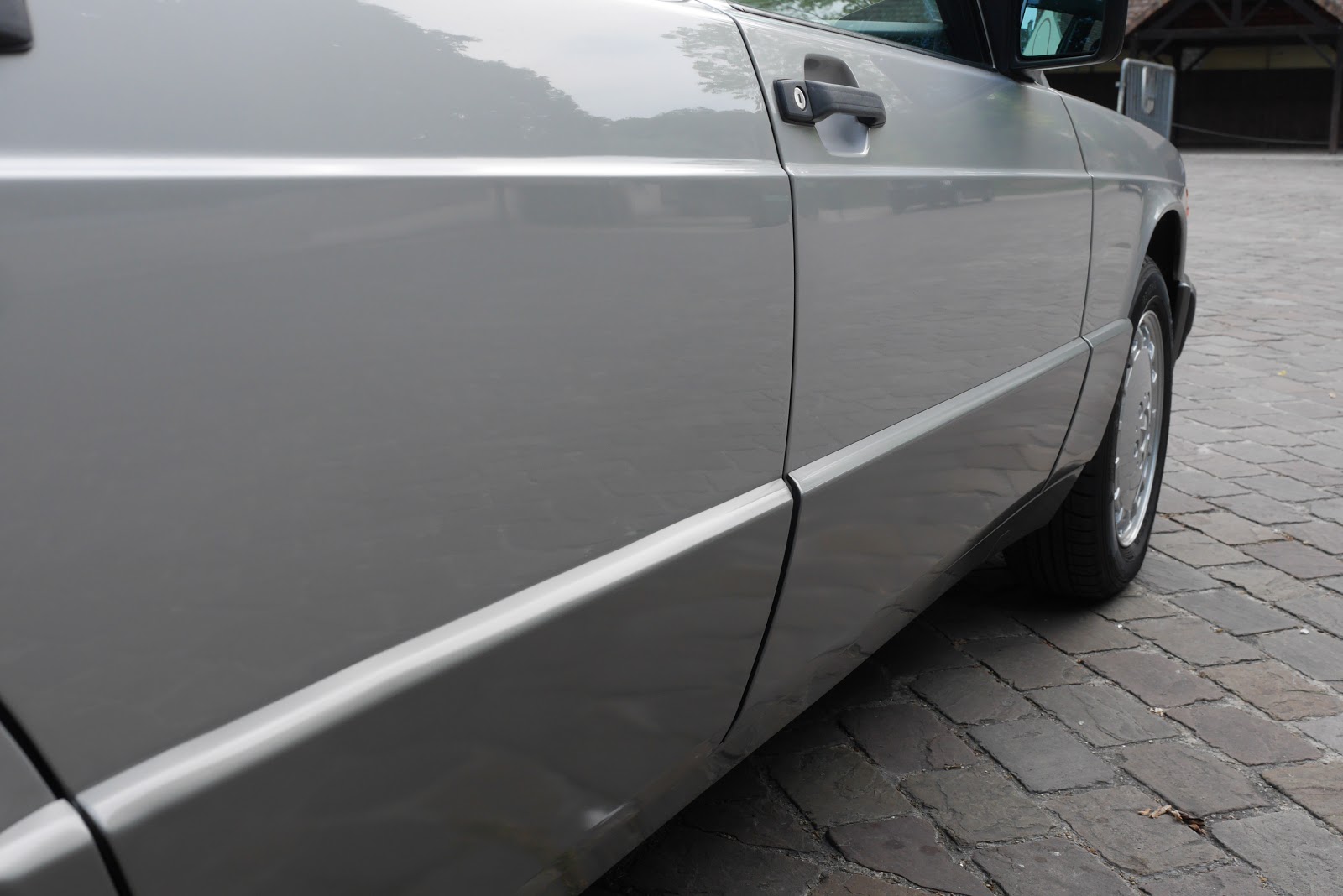
First impressions count for a lot with any car, and these Mercedes are no different. Stand back from the car and check for even panel gaps and a consistent paint colour and finish; if the car doesn’t look right, it may have suffered accident damage.

There is a big difference though between the W123 cars and the later 190 and W124 series. The W123 cars tend to suffer more from rust, especially on cars built until 1981, which used poorer-quality steel and had less rust protection applied when new. The W123 also had far more chrome trim – which adds to its appeal for many buyers now – but this can corrode, and some of these parts are costly to replace. Be wary of add-on chrome wheelarch trims (more popular in North America than in Europe), which can harbour rust.

Check along the side of the car for even
panel gaps and paintwork.
(Author's Collection)
 
Chrome side window trim adds to appeal
of C123 but is expensive to replace.
(Author's Collection)


The key spots to look at are the same across all the cars: look for rust around the wheelarches, on the wings and along the sills. One of the best guides to the condition of any Mercedes of this era is the jacking points. Remove the covers and look inside: if they are already rusting, it’s very likely that the sills will also be affected. Examine the edges of the front and rear screens, too, and on estate models the rearmost side window trims, for more traces of corrosion. Try and look underneath the car if you can, for signs of rust on the subframes and exhaust system.

The 190 and W124, especially in post-facelift guise, and on the 190 16-valve models, made more use of plastic body trim panels: these can crack or allow moisture to get in, with the result that corrosion can take hold on the metal panels underneath them.

A fine pickle! Severely corroded jacking point
and sill on 190. (Courtesy MTSV)
Rusting side window on S123 estate.
(Author's Collection)


Interior

With the huge mileages which all these Mercedes are capable of covering, it is by no means rare for unscrupulous sellers to wind back the mileage recorder. Ask yourself whether the overall condition of the interior matches the mileage shown: look at the condition of the driver’s seat bolster and for excessive wear on the steering wheel rim, gearlever and pedal rubbers. Check, too, for signs of damp on the seats, carpet or headlining, particularly on cars fitted with a sunroof, which can be a source of leaks.

Each of these series of Mercedes was offered with different types of upholstery: the legendary MB-Tex, a vinyl trim which is virtually indestructible, but can appear austere; leather, which is also hard-wearing; standard or – on the W124 and 190 – Sportline cloth, which can be vulnerable to soiling, especially in light colours; and velour, which was a luxury option in period and sets off cars such as the C123 coupés very well, but is less durable. Take note of any missing trim: some interior parts are now hard to find, especially in less popular colours.

Don’t forget to open the boot and check the condition of the spare wheel well. The boot floor is especially prone to rust on the 190.

Leather interior trim – seen here on a 
W123 250 saloon – is classy and
durable. (Author's Collection)
Rust is commonly found in the spare
wheel well on the 190. (Courtesy MTSV)

Electrics

Many fans of this era of Mercedes love the relative simplicity of their electrical systems. The older the car you are looking at, and often the lower down the model range you go, the fewer electrical accessories they tend to have. Many W123 models were delivered with manual windows, for example. In the W124 series, however, the top-end six- and eight-cylinder models often came fully equipped, so be sure to check that all the switches work as they should.

If the car you are considering is fitted with air-conditioning, has the system been overhauled and upgraded to use the current R134a refrigerant? If not, budget for an expensive service job.

Engine and mechanicals

Over the 20 years which these three series span, Mercedes fitted a huge number of different engines, but they generally have an excellent reputation. A quick look under the bonnet – which you can raise to a 90-degree service position for easier access – will often give you a good idea of how well the car has been looked after. Are there signs of oil or coolant leaks, loose hoses or corrosion under the battery, for example?

The naturally aspirated diesels, while slow by today’s standards, are some of the toughest engines ever built, easily capable of well over half a million miles.

The petrol units are not far behind, especially the mainstream four-cylinder models. Regular maintenance is essential though: on the M102 unit fitted to many models, this includes changing the simplex timing chain (fitted until 1987) every 60,000 miles. On the later six-cylinder W124 models, the engine wiring loom disintegrates over time and may need to be replaced.

Most of these cars used sophisticated but conventional suspensions, but the S123 and S124 estates, as well as the 190E 2.3-16 and 2.5-16, were originally fitted with self-levelling rear suspension. If the car sags at the rear or feels excessively hard, there may be fluid leaks in the system or problems with the pressure accumulators and pumps.

Remember to check the tyres: ideally these should be recent, with plenty of tread, and all from the same, reputable manufacturer. If the car you are considering is equipped with alloy wheels, are these free from corrosion and kerbing damage? If not, you may be able to cover the cost of refurbishing them when negotiating the price of the car.

With the bonnet in its service position,
access is easy. (Author's Collection)
If you can get underneath the car, check
for cracked springs and corrosion
on the suspension. (Courtesy MTSV)


Is restoration worthwhile?

For most of these cars, the answer today is probably not. The cost of a full-scale restoration, using high-quality OEM parts, will outweigh the value of the finished car. Unless you can afford a ‘money no object’ restoration to the exact specification you want, for most models it’s more sensible to keep looking, as there are enough cars out there.

The most sought-after models in each of these three series are, however, gradually increasing in value. The day may soon come when it does, in fact, make economic sense to restore a W123 series 280CE or 280TE or a 190E 2.3-16 or 2.5-16, for example.

 Completely stripped-down W123 bodyshell on display
at a classic car show in Germany. (Author's Collection)


Don't forget the paperwork

However good the car may look, having the right paperwork is essential. The VIN (Vehicle Identification Number) stamped on the car should match the number on the vehicle registration document. All Mercedes-Benz cars came with a data card, specifying the exact finish and equipment fitted; again, this should tally with the option codes stamped on the engine slam panel.

Finding a complete service history for a 40-year-old car may not always be possible, but evidence of recommissioning work after a period when the car has been laid up, or of recent service jobs, is all valuable. Make sure, too, that the car has a current MoT or similar roadworthiness certificate and note any ‘advisories’ indicating work which should be carried out.

VIN plate for a UK-market W123 250
automatic saloon. (Author's Collection)

Option codes plate for the author’s own
190E 2.6. (Author's Collection)

Find out more

Choosing and maintaining a modern classic from Mercedes is made all the easier thanks to the flourishing community of enthusiasts, parts suppliers and independent specialists catering to the marque. There are several newsstand magazines dedicated to Mercedes, all of which regularly feature the W123, W124 and 190, while the official Mercedes-Benz Clubs in the UK and USA are among the biggest and most professionally run single-marque car clubs.

If this feature has whetted your appetite to find out more about these great cars, why not take advantage of the special offer from Veloce Publishing on our Essential Buyer’s Guides, handy pocket-sized guides which tell you all you need to know about choosing and buying each of these models. Our latest guides cover each of the series described here, but in much more detail. 

If your mind is already set on the W123, Veloce also publishes the definitive guide to its history and development, from renowned motoring historian Brian Long.

There you have it – a round up of things to consider if you're looking to invest in a Mercedes-Benz. Along with those books mentioned by Julian, Brian Long has multiple other volumes charting the history of many other Mercedes series, and we also have Essential Buyer's Guides for 280-560SL & SLC, SL, and SLK, with one for the S-Class (another Julian Parish translation) set to publish in the spring.


About Julian Parish

Julian Parish is the author of six books for Veloce, including the Essential Buyer’s Guides to the Mercedes-Benz 190 and W123 series. A member of the Guild of Motoring Writers, he also translated the Essential Buyer’s Guide to the Mercedes-Benz W124 series from German into English. 

Julian lives in France, and as well as his automotive guides, he is the author of two popular travel guides, France: The Essential Guide for Car Enthusiasts, and The Essential Guide to Driving in Europe, and the Drive Guide Guru blog and website.


__________________________________________________________

All photos courtesy Mercedes-Benz Classic, except where otherwise shown.

__________________________________________________________


Monday, 7 January 2019

Choosing a modern classic from Mercedes with Julian Parish – Part one

Happy New Year to you all, and welcome to our first blog of 2019! 

As our very successful Essential Buyer's Guide series show (we've sold more than 175,000 copies worldwide!), here at Veloce we take buying a car very seriously, especially when it comes to classics – modern or otherwise. And if you're considering buying a Mercedes-Benz, then you're in the right place. Julian Parish, author of three Mercedes-Benz EBGs, and translator of a fourth, has written a practical two-part guide to help you decide which Mercedes is right for you – just keep reading for part one …


W123 and W124 part of a story of mid-sized saloons from Mercedes lasting 50 years.

Why choose Mercedes?

Whether it’s the latest S-Class saloon or a stylish ‘Pagoda’ SL from the Sixties, for many motorists there is nothing to match the prestige and sense of occasion that comes from driving a car with the three-pointed star. When it comes to Mercedes’ historic cars and even its so-called ‘modern classics’ built until the mid-1990s, the manufacturer’s engineering and build quality is unrivalled.

More than a quarter of a century later, its cars from the 1970s to mid-1990s can make a superb introduction to the pleasures of classic motoring: the Mercedes-Benz 190 (W201), W123 and W124 series – forerunners of the modern C and E-Class models – on which this blog focuses are among the most durable and reliable cars of their generation and can still be enjoyed today. 

The three series featured here include saloons, estates, coupés and convertibles, all with space for at least four passengers (we’ll leave the two-seater SL models for another time). If your partner or children are anxious about travelling in an older car, Mercedes was among the first manufacturers to invest massively in safety features, with anti-dive braking systems, deformable crumple zones and all-round seat belts, even on the earliest W123 models, which are now 40 years old. 

Many of these three series of cars are still available at surprisingly affordable prices (but don’t wait too long!). Parts availability is generally excellent, and service items at least are not too expensive. There is a wide choice of cars on sale and plenty of independent specialists to help keep your car running well. In the first half of this two-part blog, we’ll help you choose the right model. 

We even have a special offer to make the decision easier still!


Deciding which model is right for you

Which body style?

Like the W124 that followed it, the W123 was available in saloon, coupé and estate form.

Each of these three series of cars has its fans, so how should you decide which is right for you? Let’s begin with the body style:

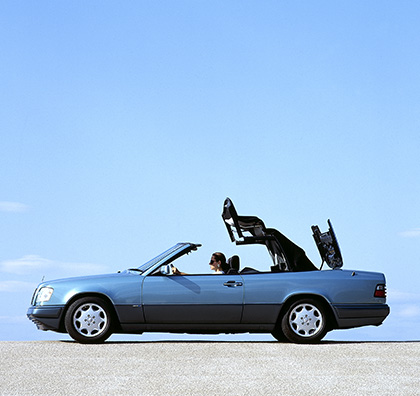
If open-air motoring with room for all the family is your priority, there is only one convertible available: the A124 model, introduced in autumn 1991 and available with a range of fuel-injected four- and six-cylinder petrol engines. The multi-layered hood ensures that the car can be driven in comfort throughout the year, while pop-up hoops behind the rear seats contribute to safety in the event of an accident. 


Electric folding hood on stylish A124 convertible.
If you are keen to enjoy one of Mercedes’ stylish two-door models but prefer a fixed roof (perhaps with the optional sunroof fitted to many cars), you can choose between the C123 and later C124 coupés. Both series have Mercedes’ famous pillarless styling, but the C123 stands out for its generous chrome trim. Make sure though that the horseshoe-shaped side window trim is in good condition: a replacement will run to nearly £1000! Most C123 coupés came in four-cylinder 230CE and six-cylinder 280CE form, but in North America, the coupé was also sold in diesel-engined 300CD spec, latterly with a turbo, to meet the Corporate Average Fuel Economy (CAFE) requirements there. The C124 models which followed are more modern to look at (which you may or may not prefer), but also have a more up-to-date feel on the road and increased power, especially in the case of the six-cylinder E320 models.


All these Mercedes coupés – from Stroke Eight (background) through C123 (centre) to C124 (foreground) had elegant, pillarless lines.

Not worried about the looks of a coupé or convertible, or in need of more space? Opting for a saloon gives you the biggest choice of all among Mercedes’ mid-sized modern classics: the 190 (W201), W123 and W124 series were all available as four-door saloons, with a huge range of diesel and petrol-engines, all the way up to the mighty 5-litre V8 fitted to the 500E/ E500. The mainstream models (particularly those with four-cylinder petrol engines) can be one of the most affordable ways of driving behind the three-pointed star, with all the quality and comfort of their two-door relatives but for less initial outlay. The 190 (aka the ‘Baby Benz’) is noticeably smaller than the other two series though, so make sure it’s roomy enough inside for your family.

190 saloon has least interior room, especially in the rear seats. (Courtesy Julian Parish)

None of Mercedes’ saloons from this era had folding rear seats, so if you need more luggage room, an estate is the obvious answer. The 190 was unique in that it was offered only as a four-door saloon, but there is plenty of choice to be found in the S123 and S124 models, with a wide range of petrol and diesel engines and, in both cases, an optional fold-out seat in the luggage compartment. This feature makes Mercedes’ estates one of the few classics able to carry a family of seven in comfort and safety and has helped drive up prices for these models today. Many of these estates have had a hard working life, so take your time if you are looking for a car in good condition with moderate mileage and a full history.


Fold-out seat in luggage compartment was available on both S123 and S124 estates.


Which engine?

Whichever Mercedes you decide on, nothing will affect the experience of driving it more than the engine you choose. 

Mercedes’ diesel engines, especially in naturally aspirated form, are among some of the longest-lived units ever produced, and have plenty of fans for their solid, imperturbable quality and moderate fuel consumption. But if you are buying a car now for high days and holidays, think carefully before choosing a diesel: the smaller four-cylinder versions especially are very slow by modern standards, developing as little as 55bhp in the W123 200D. More and more European cities are placing access restrictions on older diesels: that may not worry you now but could make it harder to sell on your car in a few years’ time.


Countless German taxi drivers relied on Mercedes’ long-lived diesels, such as this W123 in service in Stuttgart.

Most buyers today will probably opt for a petrol engine. The four-cylinder units are dependable and reasonably refined, although not particularly fast. Mercedes’ in-line sixes add more performance, but above all an extraordinarily smooth power delivery. Among the mainstream cars, the twin-cam engine fitted to the W123 280E and the 24-valve unit fitted to the W124 300E-24 are the sportiest powerplants, especially if mated to a five-speed manual transmission.


M102 four-cylinder petrol engine was fitted at different times to all three series in this feature.

If performance is your main goal, the selection is narrower, but choosing is certainly no hardship! Mercedes took the 190 into touring car racing with great success and produced an outstanding sports saloon in the form of the 190E 2.3-16, with its Cosworth-developed 16-valve engine and uprated suspension. Mercedes’ traditional customers may not have liked the bodykit and spoilers of the 2.3-16 and the larger-engined 2.5-16 which succeeded it, but it remains a compelling alternative to contemporary rivals such as BMW’s E30 M3.


Spoilers and bodykit fitted to 16-valve 190 models (here a 190E 2.5-16) were not to all buyers’ tastes.

With the larger W124 series, Mercedes took a different approach, shoehorning its 5-litre V8 under the bonnet of the 500E saloon and taking its performance to a different level altogether. Built with help from Porsche, this was a European muscle car with uprated handling to match its extra power. If the 500E is just a bit too much for you (or your wallet!), you may want to look for one of the rare six-cylinder E36 AMG models (available in the other body styles as well) or the 400E/E420 saloon with its 4.2-litre V8 and totally standard exterior appearance. This model was only sold in LHD, primarily for the North American market.


W124 E500 cornering fast on the test track.


Which transmission?

For decades, Mercedes had the reputation of building the best automatic transmissions in the business, offering the smoothest if not always the fastest changes. They are well suited to the refined character of the six-cylinder petrol engines or the torquey turbodiesels. In addition, the W123 and W124 series were fitted with a foot-operated parking brake, which many drivers find awkward for hill starts on cars fitted with manual transmission. There are no such worries with the 190, however, which has a conventional centre-mounted handbrake; the Getrag manual gearbox (with its unusual dogleg first) is a good match for the sporting 190E 2.3-16 and 2.5-16 models. 

All the Mercedes presented in this feature came with rear-wheel drive. If you regularly need to drive your Mercedes in wintry conditions but want a more luxurious all-rounder than the rugged G-Wagen, look out for one of the rare 4Matic saloons or estates, fitted with all-wheel drive. This transmission can be more expensive to maintain in later life, but a 300TE 4-Matic can make an interesting classic alternative to BMW’s 525iX and later cross-country estates from Audi and Volvo. 


Cutaway view of the 4Matic transmission offered on selected W124 models.


Which trim level and generation?


All three series of cars presented here hark back to the time before Mercedes introduced trim levels such as Avantgarde and Elegance, or the complex equipment packs it offers nowadays. Individual buyers chose the specific options they wanted, and there can be a huge difference between a basic ‘poverty-spec’ 190 or W123 200 saloon and a ‘fully-loaded’ late-model W124 E320 Coupé. The newer the car, the more equipment it is likely to have, but certain options – such as leather upholstery, a sunroof or period radio (usually from Becker) – will always add to a car’s appeal. 


Fully optioned 190E 2.3-16 with air conditioning, Becker stereo, four electric windows and heated front seats. (Courtesy Julian Parish)


Mercedes traditionally kept each of its models in production for many years (the R107 SL roadster lasted an astonishing 18 years!), with one or two facelifts along the way. In the case of the 190 and W124 series, for example, cars following the major facelift (in 1988 and 1989 respectively) can be recognised by the plastic cladding panels fitted to the lower side of the body. Mercedes also improved its cars on a continuous basis, with smaller cosmetic changes, enhanced standard equipment and even new engines being introduced between these major facelifts.

When buying now, it makes sense to buy on condition and history above all else. Be ready to settle for a different colour or forego a particular item of equipment if you find a car in the right condition. Even accepting a slightly different model or year of production may be the best decision. In general, though, cars in original specification are worth more than modified vehicles, unless the body or mechanical parts were fitted in period by top-end firms such as AMG or Brabus.


Late-model W124 saloon, with plastic side panels and Mercedes star on bonnet rather than grille.

Find out more

In the second part of this blog, we will introduce some of the main points to look for when choosing one of these Mercedes, covering in turn the exterior, interior and the engine and mechanical components. 


But if this feature has already whetted your appetite to find out more about these great cars, why not take advantage of our special Essential Buyer’s Guide offer? Get three guides – one for each of the models mentioned in this blog – for the price of just two, saving you £12.99.

You can find out more about each book and the special offer over on Julian's Drive Guide Guru website, and you can purchase direct from us.


If your mind is already set on the W123, we also publish the definitive guide to its history and development, from renowned motoring historian Brian Long.

About Julian Parish

Julian Parish is the author of six books for Veloce, including the Essential Buyer’s Guides to the Mercedes-Benz 190 and W123 series. A member of the Guild of Motoring Writers, he also translated the Essential Buyer’s Guide to the Mercedes-Benz W124 series from German into English. 

Julian lives in France, and as well as his automotive guides, he is the author of two popular travel guides, France: The Essential Guide for Car Enthusiasts, and The Essential Guide to Driving in Europe, and the Drive Guide Guru blog and website.

__________________________________________________________

All photos courtesy Mercedes-Benz Classic, except where otherwise shown.

__________________________________________________________


Thursday, 16 August 2018

Monterey Car Week

This weekend sees the start of Monterey Car Week, a special automotive week that is full of exciting events, auto shows, rallies, concours and car auctions that culminates at the Pebble Beach Concours d'Elegance on the 26th.


There are two major motoring bodies that will be unveiling new models that piqued our interest, and in today's blog post, we bring you details on these latest cars. 

The new Lamborghini Aventador SVJ will have it's official unveiling during Monterey Car Week. The newest super sports car form the famed Italian marque recently set the lap record for production cars at the Nurburgring Nordschleife, in a time of just 6:44.97 minutes. 

The Aventador SVJ is made of lightweight materials that contribute to the excellent weight-to-power ratio of only 1.98 kg/hp. Furthermore, Lamborghini's patented ALA 2.0 active aerodynamics system with aero vectoring guarantees handling and downforce. 

"Its tenure as the Nürburgring lap time record holder, even before its unveiling [this month], endorses Lamborghini's competence in applying superlative design engineering and ground-breaking technologies. The SVJ is a super sports car at the zenith of performance, while also ensuring unrivalled driving pleasure." – Stefano Domenicali, Automobile Chairman & CEO. 


It may cover an older model, but we have an impressive new tome! Our newest Lamborghini book, due for release in October, is all about the Lamborghini Murciélago. This book, written by Dr Thillainathan Pathmanathan, a lifelong Lamborghini enthusiast, examines the Murciélago in detail, while casting a look back through the marque's troubled history, to understand how the Murciélago came into being. This exceptional work touches on the people and organisation involved in the production of this iconic car, before examining each of the model variants, and discusses the joys and tribulations of ownership. 


BMW are another marque set to reveal a new car this week – rumour has it, it's a redesigned Z4. Monterey would be a meaningful venue, as BMW has a pattern of revealing concepts and production cars at this event; last year they showed 8-series and Z4 concept cars. 

So far as is known, the new Z4 will pull plenty of its design from the concept cars displayed last year, with a more forward face, and sweeping lines at the rear. As for power, BMW confirmed that a Z4 M40i will use the company's 3.0-litre twin-turbocharged inline-6. Engineers also focused on reducing the car's mass; despite the car being nearly 3 inches wider than its predecessor, the new Z4 will weigh nearly 50kg less. 

BMW's mystery reveal is set for August 23. In the meantime, if you are interested in owning a Z4, then you should first invest in our newest Essential Buyers Guide, which covers the Z4 E85 Roadster and E86 Coupe 2003-2009 – including the M and Alpina Roadster models. Packed full with loads of good advice from marque expert David Smitheram, and described as a "must have" by the Z4-forum and the BMW Car Club GB, this is the complete guide to choosing, assessing and buying the original BMW Z4. 


Wednesday, 27 June 2018

Land Rover World Record Attempt This Weekend!

2018 is a big year for Land Rover – and Land Rover publications from us – but it may be about to get even bigger with a World Record attempt in the works ...

Land Rover Monthly magazine is partnering with the Billing Off Road Show in a bid to set a new World Record for the Largest Parade of Land Rovers/Range Rovers, at the annual show taking place from the 30th of June to the 1st of July. 

Held by Germany, the current record of 632 was set on the 30th of May this year, in Bad Kissingen, but the organisers of the show, along with the LRM team, are out to bring it back to the UK. The attempt will take place on Saturday the 30th of June at 5pm, with registration on site at 1pm.

2018 marks the 70th anniversary of the invention of the Land Rover, which was created in Britain in 1948 and launched at the Amsterdam Motor Show on the 30th of April that year. 

This World Record attempt is part of the Billing Off Road Show weekend, where people from all around come to drive the Billington off-road tracks and legendary mud run. For further details of the attempt, you can visit its website.

Sarah Arrowsmith, Organiser of the show said:

"This is a momentous year for Land Rover as they turn 70. We want to celebrate it by bringing the record back to Great Britain. Land Rovers are British icons and if anyone should hold this record if should be Great Britain. We are calling on all Land Rover owners to help us smash the German held record."


The rules for the world record attempt state that the vehicles taking part must never be more than two car lengths away from the car in front, that the parade exceeds two miles, that no driver takes a toilet break, and each vehicle must have a Land Rover badge to qualify.

All those that want to take part must register on the day, and pay a small fee of £5, but each participant will receive a plaque to put on the front grille as a memento.

Over the coming months, we have a number of new Land Rover titles coming into stock, including a couple of our highly successful Essential Buyer's Guides – Land Rover Discovery Series 1 1989 to 1998 and Land Rover Discovery Series 1998 to 2004. These easy-to-follow, pocket-sized books are made to help you choose the right car – or motorbike – for you and your budget. Written by marque experts from all over the world, you'll know your in safe hands.

We have three other Land Rover books coming soon, and they cover a range of topics:

Land Rover Design details the personalities involved in the various projects from the late 1940s up to today: the designers, the modellers, and studio engineers. This book is a fitting tribute to the spirit and ethos of Land Rover design and engineering.

Land Rover Emergency Vehicles is a historic and nostalgic look at the role of the Land Rover in the emergency services. The agility and size of these vehicles made them an immediate hit with fire services, and Police forces were attracted to the cross-country ability and versatility of Land Rovers, especially outside of Britain.

Land Rovers in British Military Service is a unique and extensively illustrated book that describes and illustrates British military use. This book is perfect for anyone interested in the coil-sprung Land Rovers that have served – and still serve – with the British armed forces.


Be sure to let us know if you plan on taking part in this World Record attempt, and don't miss all of our great new Landy books!


Wednesday, 21 March 2018

Great Scott! Look at our new release!

We have a number of new Essential Buyer's Guides out this month, including the Range Rover First Generation, Mercedes Benz W123 and Mercedes Benz 190, but one in particular can be linked to an iconic movie ... 


Of course, I'm talking about the DeLorean DMC-12! The only model ever made by the DeLorean company, roughly 9000 DMC-12s were manufacturered between 1981 and 1983. Featuring a number of unusual construction details, such as gull-wing doors, a rear-mounted engine and unpainted, stainless-steel body panels, this car, though made in Ireland, was intended primarily for the US car market – though a small number were later converted post-production to be right-hand-drive, so they could be sold in other parts of the world. 

As of 2007, there were thought to be around 6500 left, and if you fancy trying to obtain one for yourself, Chris Williams' Essential Buyer's Guide is the perfect tool to help you get the best possible DMC-12 for the best possible price! Packed with good advice on everything you need to know when purchasing a second-hand DeLorean, from running costs, paperwork, vital statistics and valuation, to information on the DeLorean community, this is the complete guide to choosing, assessing, and buying the DeLorean of your dreams. 

"The way I see it, if you're going to build a time machine into a car, why not do it with some style?" – Doc Brown, Back To The Future, 1985.


Now, I may not have grown up in the '80s, but I love the Back To The Future film series! Though their prediction of the year 2015 wasn't exactly what we experienced, these films are still classics, and that is in part down to the futuristic car that made time travel possible!

As the most anticipated car of the decade, the DeLorean was gaining a lot of media attention, and teamed with its sleek, futuristic silver look, it seemed the obvious choice for Robert Zemeckis and Bob Gale to have the car as the star in their time travel film.


Three models were purchased for modification, for each film in the trilogy, with a complete fibreglass replica being built for the flying scenes in Back To The Future Part II. Of these nine in total, only three survive: the original one can be seen at the Petersen Automotive Museum in Los Angles, California; the remaining two are owned by Universal Studios, with one on display in their Islands of Adventure theme park in Orlando, Florida.

Now, I've got a couple of behind-the-scenes mechanical facts about these iconic cars. The DeLoreans used in filming retained their original V6 engines, however the sound effects artists changed the sound in post-production to the sound of a Porsche 928 V8 engine. For the American West scenes seen in Back To The Future Part III, two DeLoreans were fitted with a special dune buggy chassis, and high performance Volkswagen engines, in order to help the cars navigate the Western terrain with ease.

Whether you want to fulfil your dream of owning a time machine – in style, not in essence! – or you just always fancied owning a rare and iconic car, then you need to get a copy of Chris Williams' guide to help you find the right DeLorean! This book, and many other Essential Buyer's Guides, are available to buy from our online store now. – Siân